
Main Body
First Wave Feminism
Andrea Motekaitis, Cecilia Roe, Diana Sanchez, Giana Solazzo, Madison Andrews, and Tara Kamen
First Wave Feminism is defined as the time period from 1848 to 1920. Although the beginning of this initial “wave” of female activism began with the Women’s Rights Convention at Seneca Falls, New York, that was held in 1848, this era drew inspiration from the French Revolution and Abolitionist Movement. It was at this first meeting that a group of over 300 women and male supporters signed the “Declaration of Sentiments” proclaiming that all men and women were equal, women had a right to education and property, and suffrage (Alexander 2021). The purpose of first wave feminism then became primarily about securing a woman’s right to vote which, they believed, was the key to receiving more rights (Alexander 2021).
One of the trailblazers of this movement was Elizabeth Cady Stanton, who was essential to the fight for women’s rights, known for her intellect, writing, and unwavering commitment to social reform. Born in 1815 in Johnstown, New York, Stanton grew up in a family with considerable legal influence, her father was a prominent judge, and she was well-educated for a woman of her time. This background provided her with unique insights into the law, which shaped her perspective on women’s rights. Stanton was particularly influenced by her father’s dismissive attitudes toward women’s legal standing, inspiring her to advocate for change.
In her keynote speech at the Seneca Falls Convention, Stanton firmly positioned the pursuit of women’s rights as part of America’s democratic ideals. As the primary author of the “Declaration of Sentiments,” Stanton crafted a powerful message that resonated widely and shaped the movement. The document listed 16 grievances and 11 resolutions concerning women’s civil, social, political, and religious rights, calling for equality and demanding radical changes. One of Stanton’s key arguments was that women’s subjugation violated the founding principles of American democracy, saying in her speech, “The right is ours. The question now is: how shall we get possession of what rightfully belongs to us?” (Stanton 1848). By framing the movement in the language of freedom and equality, Stanton made it clear that gender equality was not a fringe or isolated cause but a fundamental aspect of justice and liberty.
Stanton’s demand for women’s suffrage became the central goal of the first wave of feminism, defining the movement’s focus for decades. At a time when few imagined women could or should vote, Stanton’s bold call for suffrage set her apart and became a rallying point for the movement. This focus on the vote as a means of social and political influence provided the early women’s movement with a clear, unifying goal. It inspired a generation of activists, including Susan B. Anthony, who became one of Stanton’s closest allies. Together, Stanton and Anthony traveled widely to give speeches, lobby policymakers, and organize conventions, expanding the reach and influence of the movement.
The Seneca Falls Convention and Stanton’s keynote speech defined the first wave of feminism by emphasizing both the breadth of women’s grievances and the need for systemic change. Stanton didn’t limit her vision to one or two rights but called for a fundamental restructuring of society to address inequities in education, employment, marriage, and public life. In her speech she summarizes these goals by saying, “But we are assembled to protest against a form of government existing without the consent of the governed – to declare our right to be free as man is free, to be represented in the government which we are taxed to support, to have such is graceful laws as give man the power to chastise and imprison his wife, to take the wages which she earns, the property which she inherits, and, in case of separation, the children of her love; laws which make her the mere dependent on his bounty” (Stanton 1848). Her speech established the tone of urgency and determination that came to characterize the women’s rights movement for decades. It also set a precedent for future feminist waves by linking women’s rights to broader democratic values, a strategy that lent the movement moral authority and broad appeal.
Stanton’s keynote speech thus represented a starting point that gave coherence and focus to the first wave of feminism. Her declaration and its call for suffrage framed the movement as both revolutionary and essential to the American democratic promise. This laid a lasting foundation for the fight for women’s equality, setting into motion a struggle that would ultimately achieve the right to vote in 1920 with the passage of the Nineteenth Amendment, a crowning achievement for the movement Stanton helped to ignite. Her contributions left an enduring impact on feminist philosophy, stressing that justice for women is inseparable from the ideals of freedom and equality, ideals she believed were vital to realizing America’s full democratic potential.
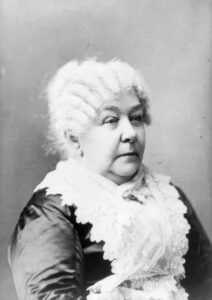
Elizabeth Cady Stanton (Credit: Brittanica)
Although Stanton was incredibly influential in defining the parameters of this movement, not all women’s perspectives or immediate needs were captured by her limited view as an affluent white woman. Women of other races and classes, specifically Black women, were not only approaching the issue from a different set of experiences, but also were not invited or welcome to participate in white feminist conventions and meetings. Thus, there was a need for trailblazers such as Isabella Bomfree, later named Sojourner Truth, to communicate those perspectives and ensure their voices were not forgotten. As a former slave who spoke nationally about feminism, abolition, and securing suffrage for all races, Sojourner Truth was able to contribute to First Wave feminism by making sure the narrative of the movement included all women. (Michals 2015).
In Truth’s Speech, “Ain’t I A Woman?” (1851) in Akron, Ohio, she speaks of her personal existence as a woman as well as her opinions on first wave feminism. She not only calls attention to the disparities in feminism in relation to her own existence as a black woman, but also disputes the critics and non-believers in the feminist movement by addressing the intersectionality between gender, religion, and race (Michals 2015). Truth’s speech is notable not only for her unique perspective as a former slave, mother of thirteen, and active feminist, but also for her unapologetic rawness with her words. Truth also used her identity as a Christian to argue with a man in the audience during her speech who commented that Christ wasn’t a woman, so men and women could not possibly be equal. In response, Truth tactfully answered “Where did your Christ come from? From God and a woman!” (Taylor 2023, p. 18). This intersectionality between gender and religion allowed for a compelling argument and the passion behind each word spoken was from not only pain, anger, and knowledge, but a charismatic calmness as Truth called the audience “children” and “honey” (Taylor 2023, p. 18).
Perhaps the most moving part of Truth’s speech is her ability to pull from her experiences of quite literally having to fight for her freedom, her survival, and the freedom of her children. She states, “I have ploughed and planted…no man could head me…I have borne thirteen children, and seen most all sold off to slavery, and when I cried out with my mother’s grief, none but Jesus heard me! And ain’t I a woman?” (Taylor 2023, p. 18). This speech is remarkable for its ability to invoke ideas about women and their contributions to society.
Sojourner’s words inspired many and the way in which she spoke was held in high regard. Frederick Douglas and Wendell Phillips “held her in great esteem,” while Harriet Beecher Stowe described her as a prophetess and Erlene Stetson, a literary critic and professor, cited Sojourner Truth as a poetess (Patten 1986). The female perspective, one which Truth has provided, demonstrates that women have worked to earn equal rights, even though they should have never had to.

Sojourner Truth (Credit: Library of Congress)
Analyzing the distinctly different perspectives of Elizabeth Cady Stanton and Sojourner Truth through their contributions to first wave feminism, highlights how polarized and exclusionary early feminist movements were.
Stanton’s speech emphasized abstract ideals, using formal, legalistic language aimed at aligning women’s rights with democratic principles like suffrage and property rights. Truth’s speech was raw, unscripted, and rooted in personal experience. Through her use of plain, direct language she was able to better communicate the immediate struggles of Black women, such as hard labor and family separation, to her intended audience.
Stanton’s approach was strategic, appealing primarily to a middle-class, white audience that valued systemic reform through law and policy. Stanton framed women’s rights as an extension of American values but overlooked the intersecting issues of race and class, focusing instead on political rights for women in her social sphere. In contrast, Truth confronted idealized notions of womanhood by asserting the strength and resilience of Black women, who were largely excluded from the protections Stanton’s vision assumed. Where Stanton sought to reform existing structures, Truth demanded a recognition of diverse experiences, challenging the movement to embrace a broader, intersectional understanding of womanhood.
In essence, Stanton’s rhetoric was aspirational, seeking legal equality for women within established societal ideals, while Truth’s was confrontational, pushing the movement to include marginalized voices and redefine what it meant to fight for “all” women. Truth challenged the fragile and idealized notions of womanhood that Stanton’s speech left unquestioned. Her speech was able to reveal the limitations of Stanton’s vision by highlighting that the experience of being a woman varied drastically based on race and social class. Truth brought the issue of intersectionality to the forefront, paving the way for second wave feminist movements.
References:
Alexander, K.L., “Feminism: The First Wave.” National Women’s History Museum. April 5, 2021. https://www.womenshistory.org/exhibits/feminism-first-wave-0.
“Declaration of Sentiments and Resolutions” (1848). (2001). In Available Means (pp. 139-). University of Pittsburgh Press. https://doi.org/10.2307/j.ctt5hjqnj.27
“Elizabeth Cady Stanton.” Education at Library of Virginia , Library of Virginia , edu.lva.virginia.gov/oc/stc/people/elizabeth-cady-stanton-(1815-1902). Accessed 28 Oct. 2024.
“Elizabeth Cady Stanton.” Encyclopædia Britannica, Encyclopædia Britannica, inc., 22 Oct. 2024, www.britannica.com/biography/Elizabeth-Cady-Stanton.
Michals, Debra. “Sojourner Truth.” National Women’s History Museum. 2015. www.womenshistory.org/education-resources/biographies/sojourner-truth.
Patten, Neil A. “The Nineteenth Century Black Woman As Social Reformer: The ‘New’ Speeches of Sojourner Truth.” Negro History Bulletin 49, no. 1 (1986): 2–5. http://www.jstor.org/stable/44176646.
Stanton, Elizabeth. “Seneca Fall Keynote Address.” July 19, 1848. https://susanbanthonyhouse.org/blog/wp-content/uploads/2017/07/Elizabeth-Cady-Stanton-Seneca-Falls-1848.pdf
Taylor, E., Gillborn, D., & Ladson-Billings, G. (Eds.). (2023): 18. Foundations of Critical Race Theory in Education (3rd ed.). Routledge. https://doi.org/10.4324/b23210