
Sacred Spaces of the Ancient Mediterranean
Dura-Europos Christian Building
The World's Oldest Baptistery
Isaac Hilton
I. Overview
Dura-Europos, a modern combination of the city’s two names, was a military stronghold located in modern day Syria on the banks of the Euphrates River.
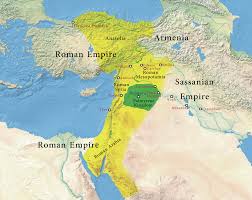
The city was originally a Babylonian town, but was restored as a military stronghold called Europos by the Seleucid general Nikanor. The city was home to a multitude of peoples, though it was originally founded as a place to house Macedonian veterans and their families. In exchange for land granted by the Seleucid kingdom, the Macedonian veterans and their descendants were required to serve in the military. Europos fell to the Parthians in 113 BCE after which Trajan vied for control before the Romans, led by Lucius Verus, eventually gained firm control in 165 CE. The city became a Roman colony sometime between 211-217 before its eventual destruction in 256 CE.
II. The Discovery
In 1898 Sarre and Schulz visited the site for the first time, but did not at the time conduct a dig. In 1912 Sarre returned with Herzfeld to explore the site in greater detail. The two found Greek inscriptions and some wall paintings, but nothing all that major. In 1920, however, British troops were passing through the region and discovered paintings in the ruins of the Temple of Palmyrene Gods. This discovery prompted further investigation, so the French academy sent American archaeologist James Henry Breasted completed the first report of the site. Eventually, the site was declared a territory within the French-Syrian protectorate, following the treaty of San Remo, and the Syrian government then granted Yale permission for a joint expedition with the French Academy. Yale’s dig lasted from 1928 to 1937 split into ten seasons. Maurice Pillet acted as field captain for the first four seasons before Clark Hopkins, a professor at Yale University, assumed the role for the remaining digs. It was on the fifth dig when Hopkins and his crew stumbled across a house near the main southeastern entrance at which they found traces of wall paintings. Hopkins and his crew continued their exploration of this building in the days to follow.[1]
III. The Location and Layout of the Christian Building
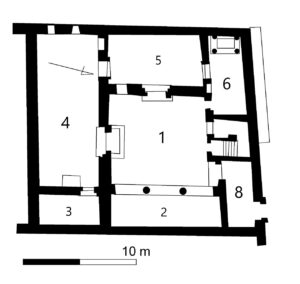
Dura was home to a vast array of sacred spaces including mithraea, synagogues, temples to various Greek, Roman, and Palmyrene gods, just to name a few. Located in the Southeastern quadrant of the stronghold is the oldest known Christian church for which we still have archaeological evidence. Estimates for the construction of this Christian building are varied, but the most widely accepted date is sometime around 250 CE. Originally built as a house, this building’s fairly modest rectangular rooms served various purposes. Perhaps the most famous of these rooms is the Baptistery located in the upper right corner of the building in quadrant 6.
The Christian building was discovered when Susan Hopkins, who was married to Clark Hopkins, discovered a fragment of parchment just outside the great gate in the southwestern quadrant of the city. The parchment read “kaisalomekai” which Hopkins and his team believed may have been a reference to Mark 16:1 which reads “When the Sabbath was over, Mary Magdalene, Mary the mother of James, and Salome bought spices so that they might go to anoint Jesus’ body.”[2] Try as they might, however, the writings on the parchment did not match any known biblical transcript of a singular book of the gospel, which prompted them to send the parchment to Carl Kraeling at Yale. Kraeling was able to determine that the text on the parchment was not from a singular book of the gospel, but an excerpt from the Diatessaron (Harmony) of Tatian, which was an amalgamation of the four Gospels into one narrative arc. This discovery serves as further evidence of an active community of Christians in Dura and indicates just how widespread the Gospel had become, even by the mid third century CE.
IV. The Wall Paintings
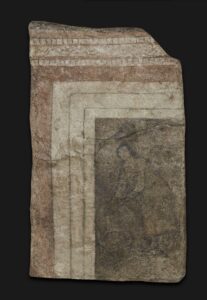
Along with various graffiti and inscriptions found within the house, there were fragmentary wall paintings discovered on each of the walls of the chapel and the entrance. As someone would enter the room, they would see the baptismal font and on the wall to its left a manuscript depiction of the famous biblical story of the woman at the well. The story, which appears in John 4, details Jesus of Nazareth’s interaction with a Samaritan woman on his pilgrimage to Galilee to be baptized by John. Jesus approaches the woman to ask for a drink from the well. The woman questions why he, a Jewish man, would be asking her for a drink, to which Jesus responds “If you knew the gift of God and who it is that asks you for a drink, you would have asked him and he would have given you living water.”[3] The woman is eventually amazed by Jesus so greatly that she converts, and evangelizes for Jesus. The wall inscription is fragmentary, but you can clearly see the central figure’s hands dangling a rope down into a hole which appears to be a well. It may be interesting to note that the figure of Christ himself is completely absent from this depiction of the story. While it is difficult to know whether that is simply a consequence of its fragmentation, some scholars, including Hopkins, highlight that the “single figure representing the word or miracle of Christ” is not uncommon in early Christian art, specifically art found in catacombs.[4]
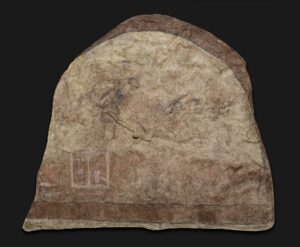
On the west wall stands the image of Christ as the good shepherd derived from Jesus’s parable found in John 10. Clearly depicted in the upper left segment of the artwork is a man carrying a sheep from his flock atop his back, with several others running out in front of him located on the right side of the drawing. In the bottom left corner, however, the figures of Adam and Eve appear somewhat strangely in the bottom left. The story in John 10 makes no mention of Adam and Eve, which, along with the clearly visible stylistic differences, has prompted scholars to theorize that the imagery containing Adam and Eve was added to the artwork after its initial creation.[5] The parable from John teaches that all sheep can find their safety from the threats of thieves, wolves, and other ailments in the arms of their good shepherd. Jesus says to the crowd of people ““Very truly I tell you, I am the gate for the sheep. 8 All who have come before me are thieves and robbers, but the sheep have not listened to them. 9 I am the gate; whoever enters through me will be saved.”[6]
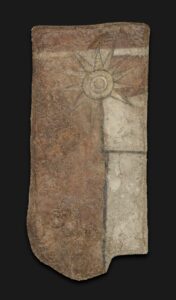
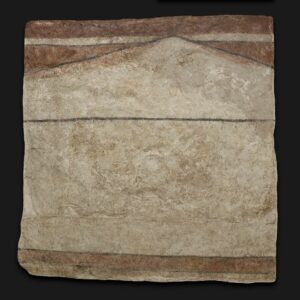
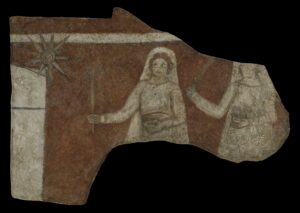
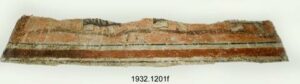
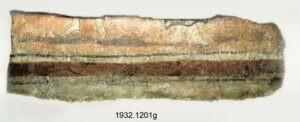
As we continue through the baptistery walls, we get less and less confident with the location of the wall paintings, as they were discovered fragmented. Perhaps the most controversial painting, with respect to the scholarship surrounding it, is the procession of the women to the tomb of Jesus. The fragments present images of female figures going towards a pentagonal shaped structure illuminated on both upper corners with stars. While classical scholarship has theorized that this drawing is a depiction of the scene from Mark 16 in which Salome, Mary Magdalene, and Mary mother of James discover the empty tomb of Jesus on the third day, or Luke 24 depicting a very similar scene including more women. The scene from Luke is the more plausible of the two, as the discovery of various female feet fragments in the chapel indicate that the original illustration must have contained roughly ten women (though scholars have debated that point quite frequently). Another interesting possibility for this illustration is to take it as a reference to psalm 19 which says “the heavens declare the glory of God; the skies proclaim the work of his hands. Day after day they pour forth speech; night after night they reveal knowledge. They have no speech, they use no words; no sound is heard from them. Yet their voice[b] goes out into all the earth, their words to the ends of the world. In the heavens God has pitched a tent for the sun. It is like a bridegroom coming out of his chamber, like a champion rejoicing to run his course.”[7] This interpretation is particularly compelling given the position of this painting relative to the baptismal font. This illustration presumably adorned the corner of the north wall and the east wall creating a procession line all the way to the baptismal font. This procession could be perceived as a metaphor for those converting to Christianity and processing into God’s heavenly tent.
Next among the wall paintings is the famous scene of Jesus encouraging his disciple Peter to walk upon the stormy seas to him. This story, found most famously in Matthew 14, but also in Mark 6 and
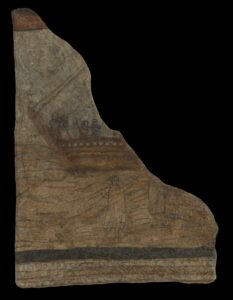
John 6, is depicted in this fragmentary wall painting found near the north wall, close to the illustration of Christ healing the paralytic. Matthew writes that Jesus, returning from his prayers to the ship with his disciples, walks atop the stormy seas. The disciples, naturally frightened by this sight, began crying out in fear. Jesus said to them “Take courage! It is I. Don’t be afraid.”[8] While the rest of the disciples were skeptical and still afraid, Peter asks the figure to call him to walk upon the water if he is truly Jesus. Jesus beckons him and Peter comes to him, able to walk upon the water as well. Quickly, however he was scared by the wind and began to sink, as his belief was dwindling. He cried out to Jesus to save him. Jesus immediately reached out and grabbed him from the waters saying “You of little faith,” he said, “why did you doubt?”[9] Jesus returned peter to the boat, and just as Jesus himself was climbing aboard, the wind and storm suddenly ceased. This prompted those in the boat to stand amazed and say to one another “Truly you are the Son of God.”[10] This parable teaches a two fold lesson. Firstly, it teaches the Christian ideal that just as Jesus saved Peter from the sea of Galilea, so too will he save all those baptized souls who believe in him. Secondly, it teaches that faith in Jesus and in god, even through what scares us, can allow us to do miraculous things. This illustration further adds to the chapel’s artistic ideology of salvation through belief.
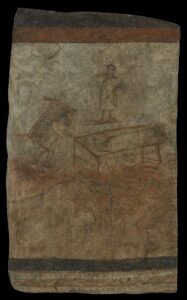
The next wall painting is a depiction of the story from Mark 2 (also found in both Luke and Matthew) of Jesus healing the paralytic man. Upon meeting this man, Jesus tells him “Son, your sins are forgiven”, to which the crowd responded by thinking to themselves that Jesus is blaspheming, thinking that surely only God can forgive sins.[11] Jesus responds to their doubtful thought. He asks “Why are you thinking these things? 9 Which is easier: to say to this paralyzed man, ‘Your sins are forgiven,’ or to say, ‘Get up, take your mat and walk’? 10 But I want you to know that the Son of Man has authority on earth to forgive sins.” So he said to the man, 11 “I tell you, get up, take your mat and go home.”[12] Immediately, the man arises and carries his mat on his back, as is seen in the illustration, and walks home. This piece was chosen to be placed in the chapel for a very similar reason to the illustration of Peter and the sea of Galilea. The primary message of these two paintings is that faith in Jesus and his forgiveness of sins allows us to do miraculous things. The rite of baptism in the early church was literally to wash away the sins (baptisms were performed almost exclusively on adults in ancient Christianity), so to have all of these depictions of miracles for those whose sins have been forgiven, implies that those who worshipped here believed they too could do miraculous things if they were to be baptized.
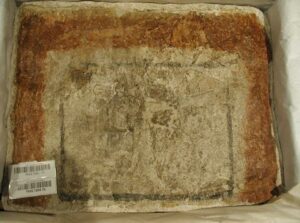
Finally among the wall paintings is the depiction of David and Goliath with an inscription just beneath it. Though not pictured here, the inscription included the name of Jesus Christ, and the dedicant of the temple, a man named Proclus. The inscription reads “Christ Jesus is yours: Remember Proclus.” a simple, but important indication that the Christian church upheld the pagan tradition of placing the name of the dedicant in a sacred space. Furthermore, on the
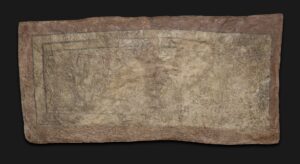
same wall as both the inscription, and the illustration of David and Goliath is a Graffito that reads “Christ Jesus: remember the humble Siseos.” The placement of this story in the chapel presents an interesting conundrum, because it is the only story that does not come directly from the text of the gospel as it comes from Samuel 1:17. Furthermore, the story of David is very prominently placed in the neighboring synagogue, which could indicate that the two sacred spaces may have shared some members of their communities. It is also important to note the placement of this painting on the southern wall in a niche next to the dedicatory inscriptions. This might imply that it was a member of the synagogue responsible for funding the renovation of the house into a chapel.
V. Conclusion
Baptism is one of the most prominent ancient Christian practices. We can see this by its prominence both in scripture, and in the writings of early Christian theologians such as Tertullian. The rite of baptism served to wash away sins and to allow those converting to Christianity to be reborn in their identities as Christians. The baptistery at Dura, more specifically the wall paintings, demonstrate the class of people who would have been drawn to Christianity in ancient societies. The wall paintings chose to feature women prominently in two of the displays, with the procession of women leading directly to the baptismal font, which indicates the prominence of women within the sphere of early Christianity at Dura. This should not come as a surprise, given the prominence of Mithraism in Dura, a religion which excludes women. Early, and particularly pre-Constantinian Christianity was aimed towards the downtrodden members of society. It is clear from the prominence of women, the sick, and the needy in the art found within the chapel that it was a place where those on the outskirts of society, without real power could unite in religious community. It was a place where they could be born again through baptism into their community of Christians.
Works Cited:
Hopkins, Clark, and Bernard Goldman. The discovery of Dura-Europos. New Haven: Yale University Press, 1979.
The new testament and psalms: New international version. Lutterworth: The Gideons International, 2009.
Peppard, Michael. The world’s oldest church: Bible, art, and ritual at Dura-Europos, Syria. New Haven: Yale University Press, 2016.
Yale University Art Gallery, Dura Europos Collection. https://artgallery.yale.edu