
Sacred Spaces of the Ancient Mediterranean
Roman Baths at Bath
Isabel Veyssi
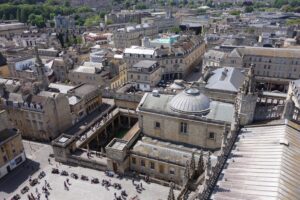
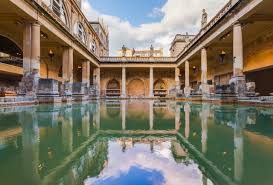
What is it?
The Roman Baths located in Bath, England are thermae that were originally built during Roman rule in Britain. Thermae are public baths from Ancient Rome that contain different rooms for various purposes. The creation of the baths led to the development of the urban settlement known as Aquae Sulis that was located around the site and many of the settlers worshiped the goddess Sulis Minerva. The Roman baths were intended for public baths and were used until the end of the Roman rule in Britain. After Roman rule these baths were left unused and many of the structures fell into disrepair until the rebuilding and remodeling of them during the Middle Ages.
Who built it?
The Roman Baths at Baths were built by the Romans at Aquae Sulis (Bath, England) because of the hot spring that was found at the site. Romans believed that hot springs were a link to the Underworld and so they turned this hot spring into a place of worship. The baths were built around 69 BCE. The building surrounding the baths was added after the Roman occupation of Britain in the Post-Roman era and it was completely finished around 1897. The added building was to not only add more room for visitors or guests, but it was also added to somewhat contain or preserve the baths because they were being used for bathing and drinking during the Victorian era. Some historians say that when the Roman Baths at Bath were built during the Roman occupation of Britain that Emperor Claudius could have possibly instructed or pushed for these baths to be built. The baths and bathing complex was used by the Romans for over 300 years while also having construction gradually happening to expand or fix up the baths.
After 300 years of use there was a decline in Roman influence in Britain and these baths fell into disrepair and were left unused. Many of the baths collapsed in themselves in the 6th century and much of the wooden piles or structure fell or broke down. The original springs that were found and were used for the bath remained and some locals used them, but they were not popular. It wasn’t until the 12th century when another bathing pool was built adjacent to the original Great Pool. The original walls surrounding the spring that were built by the ancient Roman architects and engineers were used as the foundational wall for the new bath pool. John of Tours, a priest and the doctor of William the Conqueror who later became the city’s bishop was known as the King’s bath because he was the man who came up with the idea to rebuild and add to the existing Roman baths.
What happened there?
The Baths were used for social gatherings, bathing, as well as worship specifically towards the goddess Sulis Minerva. The Roman Goddess Minerva is the goddess of wisdom, strategy and arts. Much like Athena she is often associated with war. Sulis Minerva was the primary deity of the temple spa at the Roman baths and it is said that Sulis Minerva was a goddess that was created through the mixing of the Roman goddess Minerva and the Celtic Goddess Sulis. It is likely that the Celtic Dobunni tribe worshipped her even before the Roman’s occupation in Bath. Many believed that Sulis had curative powers.
The hot springs and baths were believed to have healing properties, so many would go either for hygiene purposes or for the purpose of healing and becoming healthy. The hot spring was considered a sacred spring and people who came to the baths would go and make offerings to the hot spring whether it be jewelry, coins, cursed tablets etc. There were many rooms and features whether it be the hot spring, the cold baths, or the warm room and all of these would be used for various worship or healing practices. The baths were very important for the social life of the Romans because it was a place not only where people could practice their worship and religion, but it was also a place for socializing with friends or even conducting business. It formed a sort of a community environment where people could come together as well as participate in various cultural and religious activities.
What is there?
The Roman Baths at Bath have been developed and expanded many times throughout history and as a result there have been many rooms, buildings, and features of the Roman Baths. There are many rooms at the baths, such as, the entrance, the terrace, reception hall, the Sacred Spring, the temple, temple courtyard, the Great Bath, the circular baths, the laconicum (heated rooms) and the east and the west baths.
The Sacred Spring is considered to be one of the best preserved Roman sites north of the alps. The spring’s hot water is at 46°C and rises at the rate of 240,000 gallons every day. Because this is a natural spring, many people like the Romans did not understand how natural springs worked and how they believed it had magical or spiritual powers. The Romans built a temple next to the Sacred Spring and dedicated it to the goddess Sulis Minerva who they believed had healing powers.
The Great Bath was the center bath and piece of the Roman Bath house and it was fed hot water directly from the Sacred Spring. It was originally roofed with wood beams, but it was replaced in the 2nd century with ceramic pillars to support it more easily. Around the bath there would be benches and tables where people could eat or drink as a way of socializing.
The circular bath was a cold plunge bath that was used after treatments in the hot or warm rooms. The laconicum was a heated room (sauna) that could create steam by splashing water about the room. This would be used as a treatment before applying oil and using a strigil to clean your body. A strigil is a metal tool, normally bronze, that is curved that is used to scrape off dirt, sweat, and oil off the body after bathing. The east baths have a lukewarm bath and it was fed water directly from the Great Bath. In this section of the Roman Baths there were many heated rooms and they have been expanded and made larger throughout history until the 4th century BCE. The west baths have both plunge pools and heated rooms. There were heated rooms in the west baths and the eastern baths so that men and women could use the site simultaneously, but remain separated at the same time.
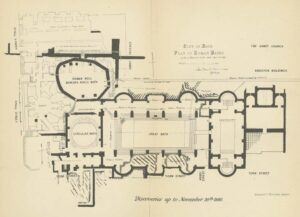
This is a map of the Roman Baths showing the Great Bath, the Circular Bath, the Roman Well beneath Kings Bath as well as other rooms and baths that had been discovered, but remained unnamed. The map or floor plan shows all of the discoveries up to November 20th, 1885.
Surroundings
Something that is interesting and important to note in relation to the Roman Baths is that it is located in a populated and industrialized or modernized city, Bath. When looking at google maps one can see that around the Roman baths are pubs, shops, churches, and restaurants that are frequently being used by residents and tourists in Bath. There are other ancient Roman spas and baths that are nearby, but the overall surroundings are modern day buildings and activities. I think this is important to note because it shows how ancient sites and artifacts can be found underneath or near places where we actually live or visit and that it shows how much could have been destroyed and has yet to be uncovered. Not only that, but it also might show how these Roman Baths might have been a place or site of importance for many generations of different people because it has been in use, kept up, or restored throughout history.
Time Periods
The Roman Baths were originally built in 69 BCE and then they were used until the end of the Roman rule in Britain in the 5th century BCE. After the Romans had left Britain many of the baths were modified for many different uses and it wasn’t until the 12th Century like mentioned before where John of Tours built a curative bath over the King’s Spring Reservoir and then later in the 16th Century more new baths were built. The baths were occasionally used by royalty and other significant and important figures throughout history, like Anne of Denmark because they were seen to be a place of healing and hygiene. The buildings around the bathing pools and Spring were constantly being built starting from the 12th Century until 1897. These buildings expanded the Roman Baths as well as created new spaces for people to visit like a museum and walking areas. Technically, the baths are still used today because of the constant visitors that are visiting the baths everyday, but people cannot go into the water because some of the baths contain toxins or bacteria that are deadly.
Artifacts found at the Baths:
There have been thousands of artifacts, relics, and ruins found at the site of the Roman Baths whether that be statues, coins, cursed tablets and more, that there is too many to cover, but below are some of the most important or famous artifacts found that are displayed at the Roman Baths Museum located on the site.
Sulis Minerva’s Head:
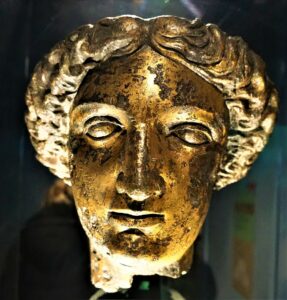
This bronze statue head is of the goddess Sulis Minerva and it was discovered at the Roman Site at Bath in 1727. This statue tells historians that the settlement’s site was not normal and instead special because it is rare to find bronze statues from Roman Britain. It is known that Minerva was worshipped at these baths and that this bronze statue might have once been placed within her temple that is next to the Sacred Spring. There might have been a great altar dedicated to her and this statue might have been looking out across her temple at the great altar. It is important to note that the head is larger than a life sized person’s head so that indicates that the statue was massive and striking to whoever was entering the temple to worship her.
Roman Curse Tablets:

There have been hundreds of cursed tablets found at the Roman Bath and there are estimated to be hundreds more at the site that have yet to be uncovered. These cursed tablets were small and thin sheets or lead or pewter that were thrown into the Spring where the spirit of the goddess Sulis Minerva lived. On the cursed tablets people would write Minerva asking for revenge or justice from some type of injustice they had suffered from. This could range from the loss of everyday items to more severe topics like asking for revenge or death on a neighbor or another person. The tablets that were discovered are estimated to be from 2nd to the late 4th century BCE.
Cursed Tablet Example:
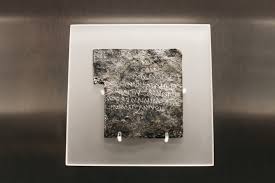
Translation:
“May he who carried off Vilbia from me become as liquid as water. (May) she who obscenely devoured her (become) dumb, whether Velvinna, Exsupereus, Verianus, Severinus, A(u)gustalis, Comitianus, Catus, Minianus, Germanilla (or) Jovina” [1]
Temple Pediment and Gorgon’s Head:
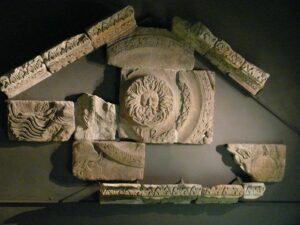
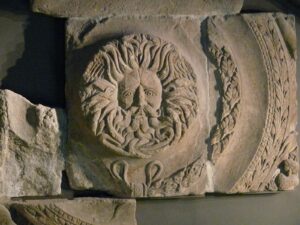
This temple pediment and Gorgon’s head discovered in 1790 is probably one of the most famous artifacts that have been found at the Roman Baths because many believe that it is probably the work of the sculptors from Gaul from the first century BCE. Gaul was a region of Western Europe that was a part of Rome which would now be present day France, Belgium, and Luxembourg. The face that appears on the pediment is a Gorgon or a water god’s head. The face is considered to be Oceanus, son of Gaia and Uranus or as the Green Man who is a Celtic Mythological figure or local Celtic sun god. The Roman Baths museum believes that this pediment has a connection to Sulis Minerva and the worship of her similarities to Athena and the myth that Perseus killed the Gorgon and presented it to Athena. In ancient Roman mythology, the Gorgon is normally seen as female, but the pediment found at Bath depicts the Gorgon as male which some argue symbolizes and represents the mixing of the Celtic and Roman traditions and histories. [2]
Ancient Literary Sources:
There are not many primary sources that mention this site, but there are two major works of literature that either briefly mention or discuss the baths. Some of these works aren’t ancient from Ancient Rome, but they are from the Middle Ages, etc.
One major work of literature that briefly mentions the Roman Baths at Bath is Geoffrey of Monmouth’s Historia Regum Britanniae by Geoffrey of Monmouth from around 1136. This is not necessarily a primary source, but it is from the middle ages and can tell us about what happened with the Baths after the Romans left and after the Roman influence had died down. According to the legend by Geoffrey of Monmouth, King Lear’s father, King Bladud is said to have been the founder of the city of Bath and that he accidentally discovered the hot springs at the Roman Bath house and realized that it had healing properties. King Bladud was known to like to take care of his pigs on his own and because of this and lack of hygiene he contracted leprosy. He knew that his family as well as others loved to bathe in the Roman Bath water so he thought that bathing might help with the inflection and after going to the baths, he realized that he was cured. He created the Roman baths as the reason for cursing his leprosy and encouraged the rebuilding and expansion of the baths.
Sources:
“Baths in Roman Britain.” English Heritage. https://www.english-heritage.org.uk/learn/story-of-england/romans/roman-bathing/.
Boag-Wyllie, Alex. “The Roman Baths in Bath.” Wilderness England, March 28, 2023. https://wildernessengland.com/blog/the-roman-baths/.
Cartwright, Mark. “Roman Baths.” World History Encyclopedia, June 20, 2023. https://www.worldhistory.org/Roman_Baths/.
Harlow, Devon. “Religion in Greece and Rome” (Class Notes, 2025).
“The History of the Kings of Britain : Geoffrey of Monmouth, Bishop of St. Asaph : Free Download, Borrow, and Streaming.” Internet Archive, January 1, 1987. https://archive.org/details/historyofkingsof00geof/page/80/mode/2up.
PICRYL – Public Domain Media Search Engine. “5 of ‘(Guide to the Roman Baths of Bath, with a Plan, Etc. (Seventeenth Edition.))’ (11183860223).” PICRYL – Public Domain Media Search Engine Public Domain Image, February 16, 2025. https://timelessmoon.getarchive.net/amp/media/5-of-guide-to-the-roman-baths-of-bath-with-a-plan-etc-seventeenth-edition-11183860223-b9d901.
“RIB 154. Curse upon Thief of ‘Vilbia.’” RIB 154. Curse upon thief of “Vilbia” | Roman Inscriptions of Britain. https://romaninscriptionsofbritain.org/inscriptions/154#translation.
“Roman Baths Museum, Non Civil Parish – 1394021: Historic England.” , Non Civil Parish – 1394021 | Historic England. https://historicengland.org.uk/listing/the-list/list-entry/1394021?section=official-list-entry.
“Roman Baths Museum, World Heritage City, Roman Britain, Bath Pump Room, Bath Tourism, Bath Spa, the Roman Baths and Pump Room, City of Bath, Venue Hire Bath, Sacred Spring UK, Georgian Architecture.” The Official Roman Baths Museum Website in the City of Bath. https://web.archive.org/web/20071102122621/http://romanbaths.co.uk/index.cfm?fuseAction=SM.nav&UUID=F9F320C4-1A95-4C04-AC609094E5B5DFD3.
“Roman Baths.” Encyclopædia Britannica, April 17, 2025. https://www.britannica.com/place/Roman-Baths.
“Roman Baths: 2,000 Years of History Are Waiting for You to Discover and Explore.” https://www.romanbaths.co.uk/.
“The Roman Empire: In the First Century. The Roman Empire. Life in Roman Times. Baths.” PBS. https://www.pbs.org/empires/romans/empire/baths.html.
Wikimedia Commons. https://commons.wikimedia.org/wiki/File:Roman_Baths_in_Bath_Spa,_England_-_July_2006.jpg.