
Sacred Spaces of the Ancient Mediterranean
Hammath Tiberias Synagogues
The Zodiac in Jewish Art
Jilly Pearson
Located on the Western shore of the Sea of Galilee in Palestine is the site of two ancient Jewish synagogues at Hammath-Tiberias. The first, Synagogue A, was excavated by Nahum Slouschz in the 1920s at the behest of the Jewish Palestinian Excavation Society.[1] Synagogue B, or the Synagogue of Severus, was excavated later by Moshe Dothan in the 1960s and is better known for its well-preserved floor mosaics.
When the synagogues were constructed, their location near the ancient city of Tiberias was of practical significance. Following the Bar Kokhba Revolt in the second century C.E., the Jewish community from Judea moved into Tiberias, and with it came not just their spiritual institutions but legislative and judicial ones as well, including the Sanhedrin and its successor, the Yeshiva of Eretz Yisrael. [2] Tiberias remained a center of Jewish life into the tenth century. [3]
Construction
Synagogue A was likely built in three stages. Like many Roman public buildings, the synagogue was in the shape of a basilica, had a central nave, and a mosaic was added to the pavement in the second building stage. [4] There may also have been baths a part of the plan for the Synagogue, as indicated by a water canal running along the outside of the structure and through the west aisle. [5] According to art historian Marilyn Joyce Segal Chiat, Synagogue A was built in 250 C.E. and was primarily occupied in the fourth and fifth centuries C.E., although it remained in use until the tenth or eleventh centuries C.E.. [6]
In Dothan’s original excavations at Synagogue B, Dothan uncovered the remains of four buildings on top of one another.[7] Dothan concluded that the first of these buildings was built in the first half of the third century C.E., and the second in the first quarter of the fourth. [8] Of the coins and ceramics found within the complex, the latest dates to 395 C.E., which is how Dothan landed on the late fourth or early fifth century as the end of the synagogue’s occupation.[9] He then determined that the third building was completed in the first quarter of the fifth century, and the last building began in the seventh and lasted until the mid-eighth century.[10] Because Dothan’s dating is based almost exclusively on numismatic evidence, more recent scholars have suggested other timelines. Chiat suggests that the first stage began as a “public building with rooms around a central court.”[11] By the third stage, Synagogue B also had a basilica and was paved with mosaics.[12] She assesses that Synagogue B was a public building in the first century C.E. before being converted to a synagogue in the third century. She claims that Stage III occurred in the fourth century and Stage IV in the fifth and sixth centuries, with the building being destroyed in the eighth century.[13] Archaeologist Jodi Magness places everything much later, with Stage I in the fourth century, Stage II in the late fourth or early fifth century, Stage III in the sixth or seventh century, and Stage IV and the Synagogue’s destruction in the ninth and tenth centuries.[14]
Art and Imagery
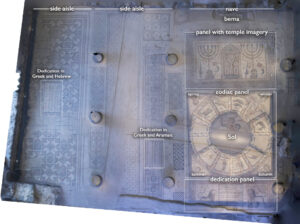
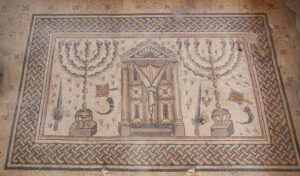
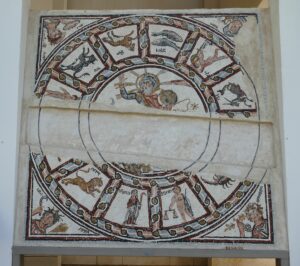
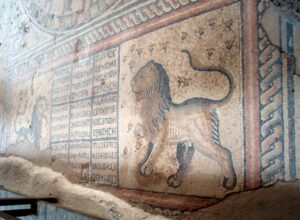
The floor mosaic in the nave of Synagogue B with temple imagery is typical of Jewish tradition.[15] It displays the Torah Shrine in the center, with a seven-branched menorah on either side. What may seem atypical of Jewish tradition is the zodiac panel adjacent. On the contrary, Hammath Tiberias is the earliest known mosaic floor of Helios and the zodiac cycle in a Jewish synagogue, but it is certainly not alone.[16] At least seven other ancient Palestinian synagogues share a similar mosaic containing Helios and the zodiac cycle.[17]
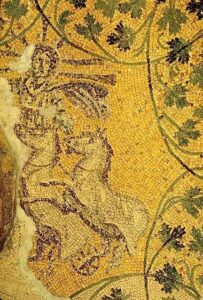
In the center of the circular zodiac mosaic in Synagogue B is Helios on his chariot, resembling Sol Invictus, a way that late Roman art depicted the emperor, similarly to Helios.[18] The mosaic also shares similarities with Christ in an early Christian tomb in the Vatican cemetery. All three show a man in a horse-drawn chariot with seven sun rays emerging from his head. At Hammath Tiberias, Helios’ hand is outstretched in a gesture that can also be seen in images of Sol Invictus, Roman emperors, and Christ.[19]
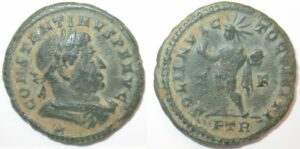
https://www.google.com/url?sa=i&url=https%3A%2F%2Fitoldya420.getarchive.net%2Famp%2Fmedia%2Fchristus-sol-invictus-18040a&psig=AOvVaw0vVZ6BqdeJq-_nAU6NfxCw&ust=1745343020831000&source=images&cd=vfe&opi=89978449&ved=0CBcQjhxqFwoTCPiPxcfT6YwDFQAAAAAdAAAAABAI
Next to the zodiac panel is a dedicatory inscription in Greek, divided into nine squares with the names of those who donated to the synagogue.[20] The Synagogue gets its name from a major donor, Severus, for whom two of the squares are devoted, and who is also commemorated in a Greek inscription between the columns of the east colonnade.[21]
Artifacts
Although Synagogue A does not have the well-preserved mosaics of Synagogue B, Slouschz did find several artifacts within the building complex. One of these artifacts is a stone seven-branched menorah similar to the one in the mosaic panel of temple imagery, with only one side finished, indicating it may have been attached to a wall.[22] Other artifacts included a stone “Chair of Moses” 94 cm. high and 60 cm. wide, and several coins and ceramics, much of which has been used to date the Synagogue.[23] Relatively little public information is available on these artifacts. As for Synagogue B, even less has been reported. Some “lamps, metal, glass, pottery vessels, and coins have been reported found in the storage rooms flanking the apse.”[24]
Broader Implications
The earlier excavations by Nahum Slouschz at Synagogue A served to reinforce developing Zionist ideologies in the region. The Jewish Palestinian Excavation Society’s first project being at Hammath Tiberias, was of no small significance. At a time when Zionists were seeking to build a nationalist identity built upon an ancient history, finding the menorah – an iconic symbol of Zionist ideology – at Hammath Tiberias was a link to the past for Jewish nation builders in the present.[25]
The mosaic of Helios and the zodiac cycle in Synagogue B, in particular, has spurred reinterpretations of Judaism in late antiquity. Some scholars point to this mosaic and others like it as evidence that “magical-mystical practices” continued after the destruction of the Second Temple in 70 C.E. despite Rabbinic sources.[26]
Bibliography
Bronstein, Judith. “Zionism, Medieval Culture, and National Discourse.” Memoirs of the American Academy in Rome 62 (2017): 119–34. https://www.jstor.org/stable/26787022.
Charlesworth, James H. “Jewish Astrology in the Talmud, Pseudepigrapha, the Dead Sea Scrolls, and Early Palestinian Synagogues.” The Harvard Theological Review 70, no. 3/4 (1977): 183–200. http://www.jstor.org/stable/1509628.
Chiat, Marilyn Joyce Segal. “Galilee.” In Handbook of Synagogue Architecture, 19–148. Brown Judaic Studies, 2020. https://doi.org/10.2307/j.ctvzpv521.10.
Cohen, Shaye J. D, and Sharon Adams. From the Maccabees to the Mishnah. Third edition. Louisville, Kentucky: Westminster John Knox Press, 2014.
Fine, Steven. Art and Judaism in the Greco-Roman World : Toward a New Jewish Archaeology. Cambridge ; Cambridge University Press, 2005.
Goodenough, Erwin R. “Pagan Symbols in Judaism: Astronomical Symbols.” In Jewish Symbols in the Greco-Roman Period: (Abridged Edition), edited by Jacob Neusner, 116–74. Princeton University Press, 1968. http://www.jstor.org/stable/j.ctt7zvg9x.8.
Hachlili, Rachel. “The Zodiac in Ancient Jewish Synagogal Art: A Review.” Jewish Studies Quarterly 9, no. 3 (2002): 219–58. http://www.jstor.org/stable/40753310.
Magness, Jodi. “Heaven on Earth: Helios and the Zodiac Cycle in Ancient Palestinian Synagogues.” Dumbarton Oaks Papers 59 (2005): 1–52. https://doi.org/10.2307/4128749.
- Judith Bronstein. “Zionism, Medieval Culture, and National Discourse.” Memoirs of the American Academy in Rome (2017), 123. ↵
- Bronstein, “Zionism, Medieval Culture, and National Discourse,” 123. ↵
- Bronstein, “Zionism, Medieval Culture, and National Discourse,” 123. ↵
- Marilyn Joyce Segal Chiat. “Galilee.” Handbook of Synagogue Architecture (Brown Judaic Studies, 2020), 103. ↵
- Chiat, “Galilee,” 104. ↵
- Chiat, “Galilee,” 105. ↵
- Jodi Magness. “Heaven on Earth: Helios and the Zodiac Cycle in Ancient Palestinian Synagogues.” Dumbarton Oaks Papers (2005), 8. ↵
- Magness, “Heaven on Earth,” 8. ↵
- Magness, “Heaven on Earth,” 8. ↵
- Magness, “Heaven on Earth,” 8. ↵
- Chiat, “Galilee,” 106. ↵
- Chiat, “Galilee,” 107. ↵
- Chiat, “Galilee,” 110. ↵
- Magness, “Heaven on Earth,” 13. ↵
- Chiat, “Galilee,” 108. ↵
- Magness, “Heaven on Earth,” 8. ↵
- Magness, “Heaven on Earth,” 3. ↵
- Magness, “Heaven on Earth,” 31. ↵
- Magness, “Heaven on Earth,” 31. ↵
- Chiat, “Galilee,” 109. ↵
- Chiat, “Galilee,” 109. ↵
- Chiat, “Galilee,” 105. ↵
- Chiat, “Galilee,” 105. ↵
- Chiat, “Galilee,” 109. ↵
- Bronstein, “Zionism, Medieval Culture, and National Discourse,” 119. ↵
- Magness, “Heaven on Earth,” 41. ↵