
Sacred Spaces of the Ancient Mediterranean
Temple to Athena at Tegea
Madeline Lenthall
Historical Background
The Temple of Athena Alea at Tegea is located in the ancient Greek city of Tegea which is modern day Eastern Arcadia in the Peloponnese region. The temple was originally dedicated to the town’s local deity Alea, but over time Alea’s identity blended with the goddess Athena, creating the merged regional deity known as Athena Alea. The people of Tegea believed the goddess offered divine protection to their city. The temple was not just a religious building, but also a sanctuary. Before it became a grand marble structure, the site served as a gathering place, and a sanctuary for the people living in the surrounding villages of early Arcadia.

Archaeological evidence suggests that the sanctuary was in use as early as the 10th century B.C.E. The temple was first built during the Late Geometric period and was much smaller than the later ones, around 4 x 12 meters. Later in the second half of the 8th century B.C.E the site was further developed. After a fire in 680-670, the Archaic temple was built, with similar dimensions to the previous Classical structure. (48.5 x 16 m). Then once again the temple was badly damaged from another fire in 395-394, which was then rebuilt again in 370-388, making history. When this temple was constructed, it was also around the same time that the polis of Tegea was flourishing. During this time there is evidence for a new agora, city walls, a theatre and a stadium. The Temple was then devastated by an earthquake in the 6th century C.E.
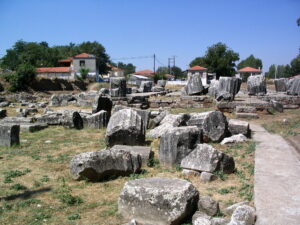
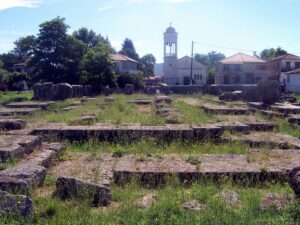
The visible foundations belong to a 4th c. BCE temple designed by the architect Scopas.
Tegea, Arkadia, Greece
The site has seen several major excavation campaigns over the years. In 1879, A. Milchhöfer began investigating the Temple of Athena Alea, followed by W. Dörpfeld in 1882. Excavations were then carried out by G. Fougeres and V. Bérard for the French School of Athens in 1888–1889. Between 1900 and 1910, G. Mendel and C. Dugas, also from the French School, led further digs. In the mid-20th century, K. Dimakopoulou conducted excavations from 1964 to 1965. More recently, since 1990, the site has been excavated by the Norwegian Institute at Athens under the direction of E. Østby.
Architectural Features
The first temple was said to be built by the city’s founder, Aleus. The second temple built in 395-394 was the more famous version of the temple built by the sculptor Scopas. Scopas’s temple became famous throughout Greece for his creative innovation. His application of architectural features like internal facades and a dramatic use of the Corinthian order, played with light and shadow in ways that were revolutionary for the time.
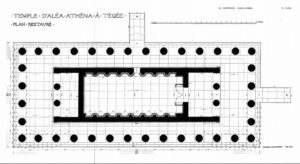
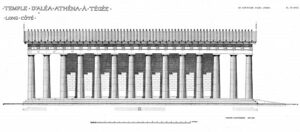
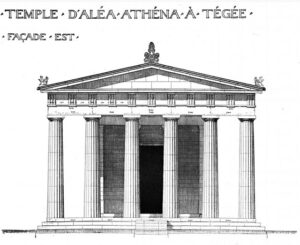
The rebuilt temple by Scopas was a peripteral hexastyle doric structure meaning it had six columns on the short ends and fourteen on the long sides. The temple was grander than other Peloponnesian temples. It was constructed with a selection of column orders (Doric, Corinthian and Ionic). Similar to the Temple built before, it used Doliana marble, but in much larger quantities. The Temple had ramps into both the entrance and on the north side of the temple, which was unusual.
The interior of the Temple of Athena Alea was divided into two main sections: the pronaos and the cella. The pronaos, or front porch, was accessed by a flight of steps and served as the formal entryway into the sacred space. Inside was a central room, which housed the cult statue of Athena Alea. This statue was made of wood and was decorated with gold and ivory.
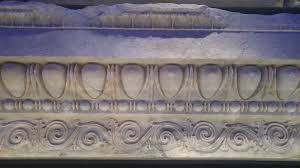
There was also an altar to Athena that included imagery references to the birth of Zeus. The temple was decorated as well: the frieze above both the pronaos and the opisthodomos (rear room) featured dramatic scenes from the Labors of Heracles, while the metopes displayed moments from the Trojan War. The Temple featured the Calydonian boar hunt on its east pediment, with Atalanta and Ancaeus who were both from Arcadia. The west pediment of the Temple depicts the combat between Telephus and Achilles at the River Kaikos.
Mythological Connection
In Arcadian mythology, Auge was a priestess of Athena at the Temple of Athena Alea in Tegea. She was the daughter of Aleus, the king of Arcadia and founder of the city. According to myth, Auge was raped by Heracles and later gave birth to a son, Telephus. Aleus’s grandson Ancaeus is another notable figure in Greek mythology. Ancaeus was one of the Argonauts and ultimately met his end during the famous Calydonian Boar Hunt.
Votive Offerings
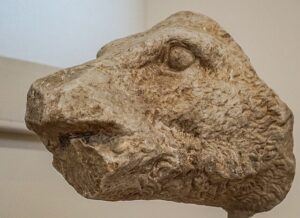
Some of the most notable votive offerings in the temple include the (decayed) hide of the Calydonian boar and the tusks of the Calydonian boar, were carried away by the Roman emperor Augustus after his defeat of Antonius and his allies. There are also chains hanging up, once worn by Spartan prisoners who were forced to dig the plains of Tegea. Among other dedications are a sacred bed or couch for Athena, a portrait of Auge, and the shield of a Tegean woman named Marpessa, also known as Choera.
Festivals and Rituals
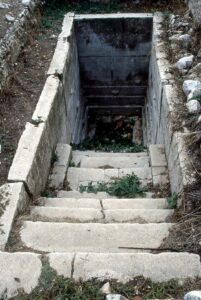
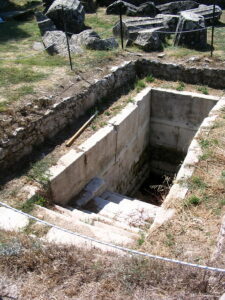
There were multiple festivals held here. One of the most significant ones was the Aleaea, dedicated to Athena Alea. Based on the limited amount of details, it most likely involved games and contests, which could have been held at the nearby stadium. There was also the Plynteria festival, which is assumed to be similar to the one held in Athens. At this festival they washed a wooden statue of Athena. They did uncover a fountain to the north of the temple that could have been used as the washing site for the ritual. They also celebrated another festival called the Holatia, because the Tegeans captured “the greater part of the Lacedaemonians alive in the battle” (Pausanias 8.47.4).
According to Pausanias, the priesthood at this sanctuary was assigned to a young boy who had not hit puberty, which is something that is uncommon at these sites. Eurpides had a play called Auge, the plot of the play has been lost, but it does take place at the Temple of Athena Alea at Tegea.
Around 550–560 B.C.E., the Tegeans joined the Peloponnesian League, which was led by Sparta, changing their relationship, as the two had often been on opposing sides prior to this alliance. The sanctuary at Tegea also played an important role as a place of refuge. According to Pausanias, the temple offered asylum to those in danger, and he even recorded the names of some notable individuals who sought its protection. These included Leotychides, a king of Sparta, and the Spartan general Pausanias. Chryseis, a priestess of Hera, also sought sanctuary there after the Heraion at Argos was destroyed by fire.
Artifacts
Artifacts found at the site include pottery, sculptural fragments, inscriptions, and items related to worship. Some are on display in museums and provide evidence of the artistic and religious practices of the time. They have also discovered bronze votive pins from ritual deposits. Bronze pins discovered in vitrified clay-lined pits, thought to be part of ritual metalworking practices. These discoveries suggest that worship here included both offering and production rituals, religion and craftsmanship were intertwined. It’s also noted that this could be a direct line to Athena because she is the goddess of craftsmanship.
Bibliography
Cardete del Olmo, M.a Cruz. “Landscape and Religious Monumentalisation in Ancient Greece: The Sanctuary of Athena Alea in Tegea.” Gerión. Revista de Historia Antigua 40, no. 2 (November 22, 2022): 405–27. https://doi.org/10.5209/geri.81668.
Goddess-athena.org. “Tegea Temple,” 2025. http://www.goddess-athena.org/Museum/Temples/Tegea.htm.
Kladouri, N.K., A.G. Karydas, V. Orfanou, V. Kantarelou, and N. Zacharias. “Bronze Votive Pins from the Sanctuary of Athena Alea at Tegea, Arcadia, Greece, Ca. 9th-7th BCE: A Microscopic and Compositional Study Using Portable Micro X-Ray Fluorescence Spectrometry (Micro-XRF).” Journal of Archaeological Science: Reports 37 (April 24, 2021): 102975. https://doi.org/10.1016/j.jasrep.2021.102975.
Østby, Erik. “The Classical Temple of Athena Alea at Tegea,” 1994. https://bora.uib.no/bora-xmlui/bitstream/handle/1956/24261/317-352%20T%20II.xvi%20Ostby.pdf?sequence=19&isAllowed=y.
Pagan Places. “Temple of Athena Alea ,” March 10, 2024. https://paganplaces.com/places/temple-of-athena-alea/.
Pakkanen, Jari. “The Temple of Athena Alea at Tegea: A Reconstruction of the Peristyle Column,” 1998. https://core.ac.uk/download/pdf/78865988.pdf.
Warwick.ac.uk. “Sanctuary of Athena Alea, Tegea,” 2019. https://warwick.ac.uk/fac/arts/classics/intranets/students/modules/greekreligion/database2/clumaj/.