Sacred Spaces of the Ancient Mediterranean
Island of Delos
Samantha Chapin
Introduction
The island of Delos held major religious and historical significance for centuries.

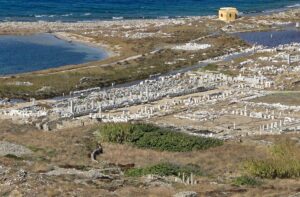
The island’s claim to its religious significance comes from the myth of Artemis and Apollo’s birth. The floating island of Delos being the only place their mother Leto could give birth. Although Artemis also has cult worship on the island, Apollo dominated more of the attention. The Sacred Area of Delos holds many temples and other structures but there are also other sites on the island. The Sacred Area includes temples to Artemis and Apollo, the Temple of Leto, temples to several other Greek gods, and other structures such as the Treasuries and the Lion Terrace. Delos’s religious significance also meant it was an attractive choice after the Persian Invasion of Greece and served as the Delian Leagues’ meeting place and also gave the League its name.
The excavations of Delos are across the island began in 1872 by the French School at Athens and are still ongoing.
What happened there?
Delos was a major pilgrimage site for centuries. Apollo received the most attention but Artemis, Leto, and Eileithyia were also prominent. While this report focuses on the Sacred Area the whole island was considered sacred. Delos did not only have worship of Greek gods and goddesses. There were also Egyptian cults such as Serapis and Isis, and what is credited as the first diasporic synagogue.
Oracle – yes or no?
While Delos was a major center of worship of Apollo, whether or not that extended to an oracle is debated. Some claim that Delos held an oracle second only to the one at Delphi and some claim that there was no oracle at all. Literary sources maintain that there were oracular practices on Delos but did not record any specific practices or prophecies. The reputation of Delos as an oracular site seems to have increased in the Roman period despite the island’s reputation as being abandoned in that era. Archaeological evidence, “Coins, pottery, and dated inscriptions attest to almost continuous habitation on the island, a continuity which lasted at least until the seventh century A.D.”[1] Overall it appears that even though Delos was a site for oracular activity, it was certainly not the island’s main claim to fame.
The Delian Games
The Delian Games were described by Thucydides in his history of the Pepolonesian war. Thucydides describes the games as having been revived by Athens at the end of the sixth year of the war after being neglected for a long time but claims that the Homeric hymn to Delian Apollo proves that there was an ancient festival. The games the Athenians initiate are based off of the description of the games found in the hymn but with some changes, such as the addition of horseracing contests.
The Athenian versions of the games were once every four years and like other games included athletics, poetry and music contests. There had been an annual festival before, and possibly during, the era of Athenian Delian Games.[2] As a festival mainly dedicated to Apollo, although Artemis and Leto both were worshiped, music held a significant role. Each city would compete and send a chorus and Delos had its own more permanent chorus. The festival was attended by men, women, and children. Thucydidies describes it as being, “just as the Ionians now go to the festival at Ephesus”[3]. Another part of the festival was the ‘Delian dance of the women’, where, “the girls of Delos, hand-maidens of the Far-shooter; for when they have praised Apollo first, and also Leto and Artemis who delights in arrows, [160] they sing a strain telling of men and women of past days, and charm the tribes of men. Also they can imitate the tongues of all men and their clattering speech: each would say that he himself were singing, so close to truth is their sweet song.”[4]
In Thucydides’ narrative of the history of the Delian Games the games were a significant event in the era of Homer and before but fell off for some time before being revived by Athens at the end of the sixth year of the Pepolonesian war. In the time that the games had faded Thycidies says that, “the islanders and the Athenians still sent choruses and sacred offerings, but the contests and most of the other ceremonies were discontinued, probably because of the difficulties of the times”.[5] That the choruses continued when other practices did not suggests that they were of particular importance.
Athenian ‘purifications’
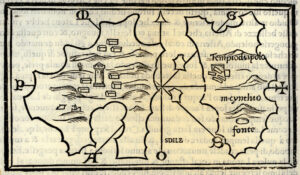
Athens’s had a long relationship with Delos, there were many important moments of this but some of the most significant were Athens’ ‘purifications’ of Delos. The first purification occurred in 425 BCE. All burials on the island were exhumed, and this process appears to have been effectively executed. Future births, deaths, and burials were also banned on the island. The burials were moved to Delos’s sister island of Rhenia and individuals were also supposed to travel to Rhenia before they died or gave birth. This obviously was more than a little inconvenient for the Delians themselves. The second major purification would take place in 422 BCE, when the Athenians expelled the Delians from their island. Athens then sent Athenians to take over all religious and secular administration of the island.
“During the armistice the Athenians expelled the Delians from Delos, thinking that, because of some crime committed in the past, they had been in a state of pollution when they were consecrated and that it was this which they had omitted to attend to at the time of the previous ceremony of purification when, as I have already described, they removed the tombs of the dead and considered that in this way the purification had been properly carried out. As for the Delians, Pharnaces gave them the town or Atramyttium in Asia, and here they settled just as they arrived from Delos.”[6]
When Rome took over Greece they gave Delos to Athens to administer as a free port. The island was attacked and looted in 88 BCE and 69 BCE leading it to being eventually abandoned. Currently the island is a museum and archeological site and has no permanent residents.
Structures
The Sacred Area on Delos contained many temples and other structures. Apollo, Artemis, and their mother Leto were of special importance. There were also several treasuries, stoa, and agora.

Legend
Archaic period Classical period Hellenistic period Roman period
Apollo’s Temples
In the Sacred Area on Delos there are three temples to Apollo in his sanctuary, the Delian Temple of Apollo (1), the Athenian Temple of Apollo (2) and the Poros Temple of Apollo (3). Interestingly rather than being built on top of one another the three temples were built side by side.
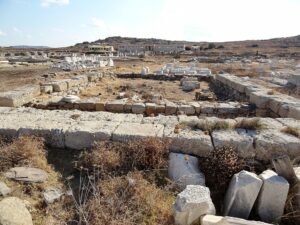
The Poros Temple was the archaic temple and served as the main temple until it was replaced by the Delian Temple of Apollo, also called the Great Temple, around 280. The Poros Temple is the smallest of the three and is a simple Anta style temple.
The Athenian Temple of Apollo, or Temple of the Athenians, is between the two and was built following the purification of 425 BCE when the Athenians removed all burials from the island and forbade anyone from being born or dying there moving forward. The amphiprostyle temple has a semi circle detail in the main room.
The third and largest temple is the Delian Temple of Apollo, or the
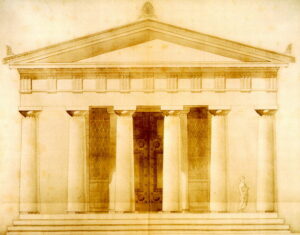
Temple of the Delians. It is the only peripteral temple on Delos, and is six Doric columns by thirteen columns. The temple began construction when the Delian League was founded in 478 BCE, paused when the leagues treasury was relocated to Athens and was only deemed complete around 280 BCE although some details were never finished.
Terrace of the Lions
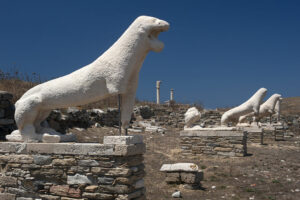
One of the most recognizable structures on Delos is the Terrace of the Lions. The terrace was built by the Naxians and consists of nine to twelve lion statues that face the Sacred Lake. Currently only five remain at the site along with fragments of three.
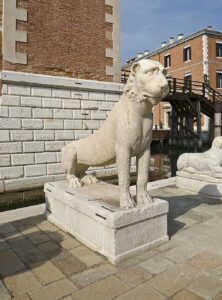
Another lion was looted and now resides outside the Arsenale in Venice. Its head was replaced in the 17th century in a style noticeably different from its siblings.
Artifacts
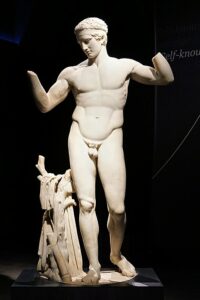
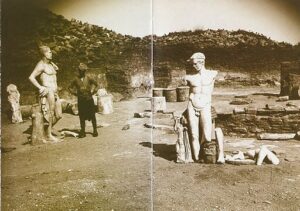
Roman statues found on Delos. The “Diadoumenos” and “Pseudo-Athlete of Delos” statues from 1st century BCE. The statues are now housed at the National Archaeological Museum of Athens.
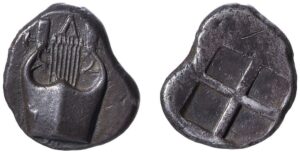
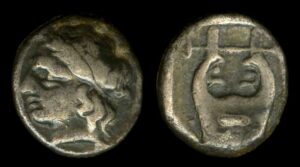
Silver coins minted on Delos, showing iconography of Apollo.
References
Den Adel, Raymond. 1983. Apollo’s prophecies at delos. The Classical World 76 (5): 288–90, http://www.jstor.org/stable/4349472.
Homer. Homeric Hymn to Apollo. Translated by Evelyn-White, Hugh G: ,http://data.perseus.org/citations/urn:cts:greekLit:tlg0013.tlg003.perseus-eng1:131-178.
Mikalson, Jon D. 1998. Athens and délos. In Religion in hellenistic athens. 1st ed. Vol. 29, 208–241 University of California Press, http://www.jstor.org/stable/jj.8501271.11 .
Moyer, Ian S. 2011. Egypt and the limits of hellenism. Cambridge: Cambridge University Press, http://ebookcentral.proquest.com/lib/conncoll/detail.action?docID=803152.
Pollini, Airton, and Sophie Montel. 2008. EUROPE, SOUTH | greece. In Encyclopedia of archaeology., ed. Deborah M. Pearsall, 1253–1267. New York: Academic Press, https://www.sciencedirect.com/science/article/pii/B978012373962900056X .
Thucydides. The Peloponnesian War. Translated by Warner, Rex, Penguin Classics.
Woodhead, A. G. 1959. The institution of the hellenotamiae. The Journal of Hellenic Studies 79 : 149–52.
- Den Adel “Apollo’s Prophecies at Delos.” 291 ↵
- Arnold “Local Festivals at Delos.” 453 ↵
- Thucydides 3.104 ↵
- "Evelyn-White translation of the Hymn to Delian Apollo" lines 155-164 ↵
- Thucydides 3.104 ↵
- Thucydides 5.1 ↵
- Key: 1. Delian Temple of Apollo 2. Athenian Temple of Apollo 3. Poros Temple of Apollo 4. Colossus of the Naxians 5. Temple of Artemis 6. Keraton 7. Treasuries 8. House of the Naxians 9. Ekklesiasterion 10. Thesmophoreion 11. Stoa of the Naxians 12. Bouleuterion 13. Prytaneion 14. Neorion or Bull Monument 15. Stoa of Antigonus 16. Propylon 17. Sacred Road 18. Agora of the Delians 19. South Stoa 20. Stoa of Philippus 21. Agora of the Competaliasts 22. Agora of Theophrastus 23. Hypostyle Hall or Stoa of Poseidon 24. Sacred Lake 25. Lion Terrace 26. Temple of Leto 27. Temple of Twelve Gods 28. Agora of Italians 29. Sanctuary of Dionysus or Stoibadeion 30. Sacred Harbour ↵