
Sacred Spaces of the Ancient Mediterranean
Temple of Magna Mater on the Palatine
Lily Rosan
Background on Magna Mater in Rome
In the year 205 BCE, in the middle of the republican era of Rome, the city was at war with Carthage for the second time. This war, the Second Punic War, had begun in 219, and Rome was struggling to defeat the Carthaginian forces led by Hannibal. In response to this crisis–and, according to Livy, showers of stones over the city–the Senate decided to consult a record of oracles known as the Sibylline books. The books instructed that a goddess known as Cybele or Magna Mater should be brought from Phrygia, a kingdom in Anatolia or modern-day Türkiye, and have a temple dedicated to her on the Palatine Hill.
As the story goes, the goddess was represented by a rock, possibly a meteorite, that was dark brown or black in color and cone-shaped. In 204 BCE, the rock was carried into the city in a procession and brought temporarily to the Temple of Victory on the Palatine. In 191, construction on Magna Mater’s own temple was completed and the goddess was moved there.[1]
The Site
The Temple to Magna Mater on the Palatine is located just southwest of the Domus Tiberiana (Figs. 1 & 2), one of the lavish imperial palaces that sit atop the hill. The temple had a cella and pronaos, in the typical Roman fashion,[2] and was a Corinthian hexastyle structure, meaning it had six columns across the front facade.[3]


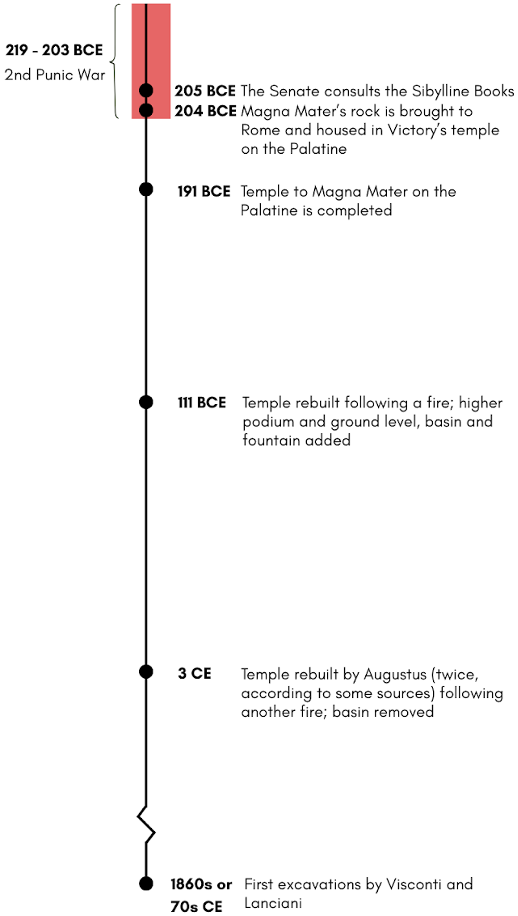
The initial version of the temple stood for eighty years, until the city caught fire in 111 BCE. The temple was rebuilt shortly thereafter in the same place, but on a higher podium and with some additions. As one author describes, “a large fountain with a basin for ritual ablutions was constructed at the foot of the monumental staircase leading from the large piazza in front of the temple to the temple itself—with the piazza providing space for other Metroac[4] rituals.”[5] At the beginning of the next century, the temple burned a second time and was rebuilt by Augustus. This renovation, in 3 CE, was more lavish than earlier versions. Augustus also removed the basin.[6] Figure 3 is a timeline of Magna Mater’s presence and the development of her temple in Rome.
Accurate excavation records for the temple are difficult to find, but it appears that the first official digs occurred in the 1860’s. The first excavators were C. L. Visconti and R. Lanciani.[7] Later, in 1950, the site was excavated further, with particular focus on the area within the cella walls. This dig produced a small collection of terracotta votives (Fig. 4), which have been dated to between 191 and 111 BCE, during the first iteration of the temple.[8] Scholars[9] have noted that while a few of the votives depict Magna Mater herself or animal sacrifices like oxen and fowl, the vast majority of the offerings are effigies of Attis, another deity associated closely with Magna Mater and usually described as her lover.

Who is Magna Mater?
The goddess’s origins in Phrygia are of great importance to her reception in Rome. The Romans saw themselves as descendants of the kingdom of Troy in Anatolia, so the Anatolian goddess became the ancestral mother of Rome.[10] Some of Magna Mater’s epithets demonstrate this connection to Troy. For example, she is often called “Idaean” or the “Idaean Mother” for Mt. Ida in Troy. In fact, her official title upon arriving in Rome in 204 BCE was Mater Deum Magna Idaea, meaning “Great Idaean Mother of the Gods.”[11]

In line with these notions, Magna Mater was also a goddess of fertility, agriculture, and motherhood.[12] She is associated with pastoral symbols such as wheat and mountains, and she is often identified with other deities more prominent in the Roman pantheon, like Ceres (Demeter to the Greeks[13]), Rhea, and Gaia.[14] She is also a protector goddess for Rome, associated with the city walls and the sacred boundary (called the pomerium) that encircled the city.[15] She is often depicted with a crown in the shape of walls or turrets (Fig. 6).

Magna Mater was celebrated in Rome with a festival called the Megalensia,[16] which like took place from April 4th to April 10th each year. The festival was intended to commemorate the goddess’s arrival in the city and celebrate the prosperity she brought to Rome. Sources on the exact rites and practices undertaken for the festival are inconsistent, but there are a few activities that appear consistently. The festival included a procession through the city–perhaps in an attempt to recreate the procession of Magna Mater’s initial arrival to the Palatine–culminating in the ritual bathing of the goddess’s cult statue (or her cone-shaped meteorite).[17] The Megalensia also involved a banquet, the sacrifice of a heifer, circus games such as chariot racing, and theatrical performances. The festival was also the only time during which Magna Mater’s temple was open for regular worshippers to bring sacrifices and votive offerings.
The Galli
Perhaps the aspect of Magna Mater’s cult in Rome that has most captured the attention of scholars today is not the goddess herself but her priests, known as galli (Fig. 7). Neither Roman citizens nor slaves were allowed to become galli; only foreigners were permitted to do so.[18] This is because the galli did not conform to traditional Roman gender roles or social norms. They were traditionally castrated males, a characteristic heavily emphasized by Roman writers and modern scholars alike.[19] Our Roman authors approach the galli with a sort of condescending disgust but cautious fascination, and literary sources often refer to them as half-men or as some third gender. The Romans seem to have used either feminine or a combination of masculine and feminine pronouns to refer to the galli.[20]

Just as Roman worshippers could only enter the Palatine temple during the Megalensia, the galli were only permitted to leave the temple complex during the few days out of the year that made up the festival.[21] They performed the procession and ritual bathing of the goddess that occurred during the festivities, and also engaged in ritual alms-begging during the celebration. Roman authors report that the galli had a distinct appearance, wearing feminine garments and Phrygian caps or crowns. More striking, the priests are also said to have depilated their legs, curled their hair, and covered themselves in perfumed oils.[22]
“Don’t torture your hair, though, with curling-irons: don’t pumice your legs into smoothness. Leave that to the Mother Cybele’s votaries, ululating in chorus with their Phrygian modes. Real men shouldn’t primp their good looks,” Ovid, Ars Amatoria[23]
Conclusion
The cult of Magna Mater and the galli are a fascinating case study in Roman religion because they are not typically “Roman.” Magna Mater provides a window into the ways in which Rome was a diverse, multicultural city, especially when it comes to religious practice. Though Magna Mater and her cult are unique in many ways, this goddess is merely one example of the Roman practice of importing and syncretizing foreign deities into the official religion of the state, crafting a dynamic and colorful pantheon. Magna Mater and the diversity of Roman religion can serve as a reminder for us that Rome was not a monolith.
Bibliography
Boin, Douglas. “A LATE ANTIQUE STATUARY COLLECTION AT OSTIA’S SANCTUARY OF MAGNA MATER: A CASE-STUDY IN LATE ROMAN RELIGION AND TRADITION.” Papers of the British School at Rome 81 (2013): 247–77. http://www.jstor.org/stable/42706323.
Burton, Paul J. “The Summoning of the Magna Mater to Rome (205 B.C.).” Historia: Zeitschrift Für Alte Geschichte 45, no. 1 (1996): 36–63. http://www.jstor.org/stable/4436406.
Elder, Olivia. “Population, Migration and Language in the City of Rome.” Chapter. In Migration, Mobility and Language Contact in and around the Ancient Mediterranean, edited by James Clackson, Patrick James, Katherine McDonald, Livia Tagliapietra, and Nicholas Zair, 268–95. Cambridge Classical Studies. Cambridge: Cambridge University Press, 2020.
Latham, Jacob. “‘Fabulous Clap-Trap’: Roman Masculinity, the Cult of Magna Mater, and Literary Constructions of the Galli at Rome from the Late Republic to Late Antiquity.” The Journal of Religion 92, no. 1 (2012): 84–122. https://doi.org/10.1086/662205.
Latham, Jacob. “ROMAN RHETORIC, METROAC REPRESENTATION: TEXTS, ARTIFACTS, AND THE CULT OF MAGNA MATER IN ROME AND OSTIA.” Memoirs of the American Academy in Rome 59/60 (2014): 51–80. http://www.jstor.org/stable/44981972.
Littlewood, R. J. “Poetic Artistry and Dynastic Politics: Ovid at the Ludi Megalenses (Fasti 4. 179-372).” The Classical Quarterly 31, no. 2 (1981): 381–95. http://www.jstor.org/stable/638544.
Livy, The History of Rome, trans. Rev. Canon Roberts, (New York, NY: E. P. Dutton and Co., 1912).
Meyer, John Clifford. “Arcessite divum matrem: The homecoming of the Great Mother to Rome.” Acta Classica 65 (2022): 113-140. https://dx.doi.org/10.1353/acl.2022.0006.
Roller, Lynn E. 1999. In Search of God the Mother : The Cult of Anatolian Cybele. Berkeley, Calif: University of California Press. https://research.ebsco.com/linkprocessor/plink?id=89bdc86a-a938-3b81-9874-09071ed55a37.
Satterfield, Susan. “Intention and Exoticism in Magna Mater’s Introduction into Rome.” Latomus 71, no. 2 (2012): 373–91. http://www.jstor.org/stable/41547220.
Stanford University Libraries. “The Urban Legacy of Ancient Rome: Photographs from the Ernest Nash Fototeca Unione Collection.” Accessed May 12, 2025. https://exhibits.stanford.edu/nash/feature/m.
University of Chicago. “Temple Architecture.” Accessed May 12, 2025. https://penelope.uchicago.edu/encyclopaedia_romana/architecture/templearchitecture.html.
Vergil, Aeneid, trans. Theodore C. Williams, (Boston, MA: Houghton Mifflin Co., 1910).
Vitas, Nadežda Gavrilović. “Magna Mater.” In Ex Asia et Syria: Oriental Religions in the Roman Central Balkans, 13–48. Archaeopress, 2021. https://doi.org/10.2307/j.ctv1gt94hj.9.
Wallace-Hadrill, Andrew. “Imperial Rome: A City of Immigrants?” 2017. Acta Ad Archaeologiam Et Artium Historiam Pertinentia 29 (15 N.S.): 53-72. https://doi.org/10.5617/acta.6076.
Wikimedia Commons contributors. “File:Bronze statuette of Cybele.jpg,” Wikimedia Commons. Accessed May 12, 2025. https://commons.wikimedia.org/w/index.php?title=File:Bronze_statuette_of_Cybele.jpg&oldid=835052120.
Wikimedia Commons contributors. “File:Depositi votivi del tempio della magna mater, 210-100 ac ca.jpg,” Wikimedia Commons. Accessed May 12, 2025. https://commons.wikimedia.org/w/index.php?title=File:Depositi_votivi_del_tempio_della_magna_mater,_210-100_ac_ca.jpg&oldid=923306543.
Wikimedia Commons contributors. “File:Guide to Italy and Sicily (1911) (14579345070).jpg,” Wikimedia Commons. Accessed May 12, 2025. https://commons.wikimedia.org/w/index.php?title=File:Guide_to_Italy_and_Sicily_(1911)_(14579345070).jpg&oldid=1010313941.
Wikimedia Commons contributors. “File:Magna mater, 150 dc ca. da orig. pergameneo del II secolo ac., dal tempio della magna mater.jpg,” Wikimedia Commons. Accessed May 12, 2025. https://commons.wikimedia.org/w/index.php?title=File:Magna_mater,_150_dc_ca._da_orig._pergameneo_del_II_secolo_ac.,_dal_tempio_della_magna_mater.jpg&oldid=737416272.
Wikimedia Commons contributors. “File:Palatin-legende.jpg,” Wikimedia Commons. Accessed May 12, 2025. https://commons.wikimedia.org/w/index.php?title=File:Palatin-legende.jpg&oldid=1010328844.
Wikimedia Commons contributors. “File:Statue of Gallus priest.jpg,” Wikimedia Commons. Accessed May 12, 2025. https://commons.wikimedia.org/w/index.php?title=File:Statue_of_Gallus_priest.jpg&oldid=511036995.
Wiseman, T. P. “Cybele and Attis.” Accessed May 12, 2025. https://www.oxfordreference.com/display/10.1093/acref/9780195170726.001.0001/acref-9780195170726-e-329#. Schultz, Celia E. “Sibyls and the Sibylline Books.” Accessed May 12, 2025. https://www.oxfordreference.com/display/10.1093/acref/9780195170726.001.0001/acref-9780195170726-e-1162?rskey=gCDbBd&result=2.
- Vitas 2021, p. 16-17 ↵
- See this resource for more information on Roman temple architecture. ↵
- Meyer 2022, p. 127 ↵
- "Metroac" is a term used to refer to Magna Mater or Cybele and her cult, including both priests and rituals. A temple or sanctuary space dedicated to the deity is often referred to as a "metroon" (Greek) or "maetreum" (Latin). All three terms are also sometimes used in association with mother goddesses more generally, or in reference to goddesses like Hera/Juno or Demeter/Ceres. ↵
- Latham 2012, p. 94 ↵
- Vitas 2021, p. 17 ↵
- The Urban Legacy of Ancient Rome, Stanford University Libraries ↵
- Meyer 2022, p. 127 ↵
- Meyer 2022, p. 127 ↵
- Vitas 2021, p. 17 ↵
- Vitas 2021, p. 17 ↵
- Vitas 2021 ↵
- Magna Mater or Cybele was also worshipped in the Greek world, possibly starting as early as the 6th century BCE. ↵
- Vitas 2021, p. 14 ↵
- Meyer 2022, p. 127 ↵
- Littlewood 1981 ↵
- Ibid. ↵
- Meyer 2022, p. 114 ↵
- Latham 2012 ↵
- Ibid. ↵
- Littlewood 1981 ↵
- Latham 2012; 2014 ↵
- As quoted in Latham 2012, p. 84 ↵