
Sacred Spaces of the Ancient Mediterranean
Temple of Isis at Pompeii
Eloise Strabley
The Myth of Isis
The god Typhon devised a trap for Isis’ husband and brother Osiris, who was the king of the gods. Typhon had a coffin/chest built that was the perfect size for Osiris, and promised the gods that whoever fit in the chest could have it to keep. When Osiris lay down in it, Typhon and his allies sealed the chest and sent it to the sea. When Isis learned of what had happened, she wandered the world searching for her husband. Eventually she found the chest and entrusted it to her son Horus to hide. Typhon soon found out, and divided Osiris’ body into fourteen parts, scattering them across the world. Isis gathered all parts but one together. Missing the phallus, Isis made a replica and resurrected her husband. Horus and Osiris battled Typhon and brought him to Isis in chains. Faced with the god who had killed her husband, Isis released him. Perhaps this is where the ritual of manumission through Isis comes from.
The Cult of Isis
The Cult of Isis was a mystery cult, meaning most of its practices were never recorded and are thus lost to history. It seems that the cult had wide appeal, with members being slaves, women, freedmen, as well as wealthy male citizens. Within the cult, men and women participated equally.
Through Isis, a slave could be transformed into a freedman. Manumission was the process of releasing a person from slavery. This could be done through a variety of different ways, but in the Cult of Isis slaves could be freed through fictitious sales to the goddess.
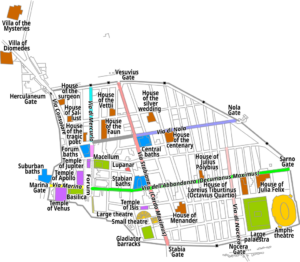
https://commons.wikimedia.org/wiki/File:Pompeii_map-en.svg
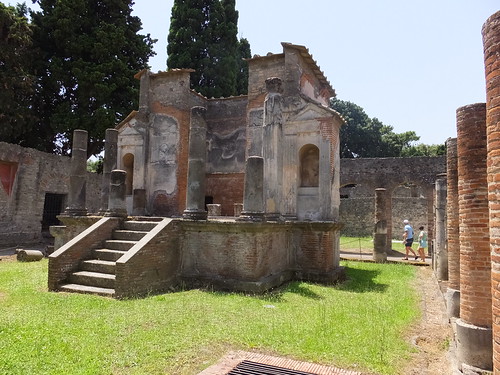
The Temple of Isis
The Temple of Isis at Pompeii was one of the first temples discovered during the Pompeii excavation, in 1764, and is possibly one of the first sanctuaries to the Egyptian gods ever built in Italy. Dedicated to the Egyptian goddess Isis, this temple was located behind Pompeii’s main theater, closest to the Stabia gate. The entrance was accessible through a small doorway that opened out onto the Via del Tempio di Iside. This protected the interior portico area from foot traffic and also made it possible to restrict entry to cult initiates at times.
The Temple of Isis was originally built sometime during Emperor Augustus’ reign in the 2nd century BCE. It is located behind Pompeii’s main theater. This is thought to be because Osiris, Isis’ husband and brother, was often associated with Dionysus. After an earthquake in 62 CE damaged the temple, it was rebuilt through donations from members of the community, including the wealthy freedman Numerius Popidius Ampliatus in his son’s name.
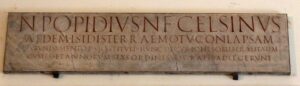
https://commons.wikimedia.org/wiki/File:Naples_Museum_95_%2815208718708%29.jpg
Indeed, it seems the Cult of Isis held political sway in Pompeii. An inscription across the street from the Temple of Isis read “Popidius Natalis the client – along with the Isiaci – asks for Cuspius Pansa for aedile.” On the same insula was another inscription, “All the Isiaci sponsor Cn. Helvius Sabinus.” It is possible these were from campaigns for the same race, but this theory cannot be proven. However, the endorsement of candidates suggests organization and hierarchy within the Cult of Isis in Pompeii.
Inside the Temple
The temple is on a podium in the center of a porticoed courtyard. Within the temple is the pronaos, a porch-like area surrounded by columns. Walking through there, a worshipper would then reach the naos, which contained cult statues of Isis and Osiris. There are niches on the wall that at one point possibly displayed statues of Harpocrates and Anubis. Stairs in the back of the naos lead back out into the courtyard, most likely for officiants to use.
Outside the temple, the portico was decorated with frescoes depicting offerings, the reading of ritual texts and the god Anubis. On the East wall, facing the front of the temple was a shrine to Harpocrates. In the Southeast corner of the courtyard there is a roofless enclosure called a Purgatorium. This contained a basin of Nile water used for purification rituals. Behind the temple is the Ekklesiasterion, a hall used for cult gatherings and ritual banquets.
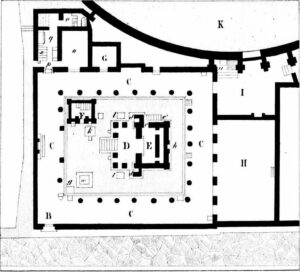
C. Shrine of Harpocrates
D. Pronaos
E. Naos
F. Purgatorium
H. Ekklesiasterion
I. Sacrarium
e. Stairs
https://jenikirbyhistory.getarchive.net/amp/media/pompeii-regio-08-insula-07-temple-of-isis-plan-01-a70b01
The Ekklesiasterion
There is very little known about the initiation process and proceeding membership activities within the Cult of Isis. Due to evidence and artifacts found within the Ekklesiasterion, it is evident that animal sacrifices and feasts were held in the hall. Specifically there is evidence of a banquet that occurred between the earthquake in 62 CE and the eruption of Mount Vesuvius in 79 CE where eight chickens, a goose, a turtle dove, a pig, and two clams were sacrificed and eaten. The ritual was likely performed by three priests of Isis in a single day, possibly to atone for renovations that made the temple smaller. The Dutch historian Jan Bremmer believes the specific animals chosen for the ritual indicate Isis wasn’t an important god in Roman worship at the time, because she would have received more important animals such as cattle if she were.[1] The sacrifices that took place within the Ekklesiasterion are similar enough to the cult sacrifices at other temples of Isis to show that there was communication between different congregations across the Mediterranean world.
Other notable objects found inside the Ekklesiasterion include:
- A Sistrum
- A male skeleton
- A table
- A bronze latch with a keyhole
- A terracotta vase
- A bronze cooking pot
- Tableware made of glass
- Tableware decorated with pearls
- The head of a sculpture of Isis, most likely fallen from the roof
The Myth of Io
In traditional Roman myth, Jupiter kidnaps Io and then transforms her into a cow to hide her from Juno. Juno requests that Jupiter give her Io, and places her under the guard of Argus. Mercury sets Io free, and Io is chased by a gadfly sent by Juno until she reaches the banks of the Nile, where Jupiter returns her to her original human form.
Often there was a conflation of Isis and Io, possibly because both were sometimes portrayed with bovine-like features. Other versions of the myth end in Io becoming a devotee of Isis.
The Frescoes of the Ekklesiasterion
The walls of the Ekklesiasterion were decorated with 3 frescoes depicting the myth of Io. The first painting depicted Mercury, Argus and Io. The second was of Io and Argus, with a rock between them. The third fresco is by far the most interesting. It illustrates the scene in which Io arrives in Egypt and is transformed into a human once more. This painting is different from the myth in that it depicts Isis performing the transformation, and not Jupiter.

Apuleius’ Metamorphoses
Similar to this Isiac version of Io’s myth is the tale of Apuleius’ The Golden Ass, in which a curious Lucius interferes with magic beyond his comprehension and is turned into a donkey. He faces many hardships (mostly as a result of his own foolishness), but ultimately is given the tools to transform back into a human by the goddess Isis, in exchange for his initiation into the cult. This fiction novel is one the few sources that discuss the mysteries of Isis and initiation rites into the cult. Lucius undergoes a purification ritual and has to pay in order to join the cult. Still, the true initiation is shrouded in mystery.
The Mosaic
The floor of the Ekklesiasterion is tiled with a mosaic. Three names were recorded in the mosaic: N Popidi Ampliati, N Popidi Celsini, Corelia Celsa. The first two names are genitive, and the third is either ablative or nominative. This has caused much debate among scholars, but archeologist Molly Swetnam-Burland says there is no need for a debate at all, because this is due to a mistake of the records.[2] The archeological records show that excavators worked from the threshold towards the back wall when uncovering the mosaic and the names were recorded in the order in which they were found. However, they were meant to be read from the back wall towards the entrance. The order really should be Corelia Celsa [wife of] N Popidi Ampliati, [mother of] N Popidi Celsini. Corelia Celsa is the dedicator in the nominative, and her relationship to her family is shown through the genitive. The name N Popidi Celsini also appears in the inscription above the entrance to the temple, as the six-year-old admitted to the town council.
The Sacrarium
Beside the Ekklesiasterion is the Sacrarium, which was a multipurpose storeroom and shrine used for personal devotions to the goddess. Found within this room were portrait heads, an iron tripod, a glass carate, a bronze sacrificial knife, and sculpture fragments. These fragments are sculptures of two women and one man. Based on the hairstyles and clothing of the women statues, they were dedications paid for by wealthy women in Pompeii who wanted their image associated with the goddess.
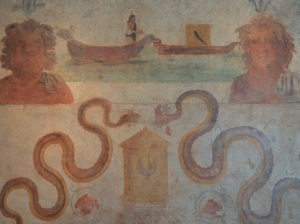
Shrine Painting
Inside the sacrarium is a shrine containing a scene of Isis-on-the-Nile. This scene shows Isis tending the remains of a murdered Osiris in the moment before his resurrection. Both Serapis and Apis are represented, as well as two cobras, the snake Isis was most closely associated with.
Conclusion
The Cult of Isis in Pompeii held great political power, despite being open to members of all classes, races, and genders. It may seem that the Cult of Isis was progressive and welcoming. In some ways it was, but in other ways it only further entrenched practices like slavery in the Roman world. The practice of manumission through Isis encouraged enslaved people to work harder, because they were given proof that if they worked hard enough they could be freed legally. Working harder made slaves more profitable, thus giving slaveowners incentive to keep their slaves. At the end of the day, the Cult of Isis was a cog in the machine that made Imperial Rome run, and that reality must not be hidden behind a Wizard of Oz-like curtain of progression.
Sources Cited:
Swetnam-Burland, Molly. “The Sanctuary of Isis in Pompeii: Dedication and Devotion, Myth and Ritual.” Chapter. In Egypt in Italy: Visions of Egypt in Roman Imperial Culture, 105–41. Cambridge: Cambridge University Press, 2015.
BRENK, FREDERICK E. “A Gleaming Ray: Blessed Afterlife in the Mysteries.” Illinois Classical Studies 18 (1993): 147–64. http://www.jstor.org/stable/23064442.
Plutarch. Moralia, Volume V: Isis and Osiris. The E at Delphi. The Oracles at Delphi No Longer Given in Verse. The Obsolescence of Oracles. Translated by Frank Cole Babbitt. Loeb Classical Library 306. Cambridge, MA: Harvard University Press, 1936. DOI: 10.4159/DLCL.plutarch-moralia_isis_osiris.
“Exploring the Temple of Isis in Pompeii: A Glimpse into Ancient Religious Life – Pompeii Archaeological Park,” June 16, 2024. https://pompeiiarchaeologicalpark.com/exploring-the-temple-of-isis-in-pompeii-a-glimpse-into-ancient-religious-life/.
Metcalfe, Tom. “Ancient Romans Sacrificed Birds to the Goddess Isis, Burnt Bones in Pompeii Reveal.” Live Science, May 16, 2023. https://www.livescience.com/archaeology/romans/ancient-romans-sacrificed-birds-to-the-goddess-isis-burnt-bones-in-pompeii-reveal.
“Tempio Di Iside|mann Napoli.” Accessed April 29, 2025. https://museoarcheologiconapoli.it/en/tempio-di-iside-2/.
“The Controversy of Numerius Popidius Celsinus: Fact or Forgery? – Pompeii Archaeological Park,” June 16, 2024. https://pompeiiarchaeologicalpark.com/the-controversy-of-numerius-popidius-celsinus-fact-or-forgery/.
- Metcalfe, Tom. “Ancient Romans Sacrificed Birds to the Goddess Isis, Burnt Bones in Pompeii Reveal.” Live Science, May 16, 2023. https://www.livescience.com/archaeology/romans/ancient-romans-sacrificed-birds-to-the-goddess-isis-burnt-bones-in-pompeii-reveal. ↵
- Swetnam-Burland, Molly. “The Sanctuary of Isis in Pompeii: Dedication and Devotion, Myth and Ritual.” Chapter. In Egypt in Italy: Visions of Egypt in Roman Imperial Culture, 105–41. Cambridge: Cambridge University Press, 2015. ↵