
Sacred Spaces of the Ancient Mediterranean
Columbaria at Vigna Codini
Stevie Checkoway Thomsen
Site Features
The Columbarium at Vigna Codini serves as an Early Roman repository for cremated human remains, much akin to a mausoleum cemetery structure. Columbaria refers to subterranean large burial structures for non-elite Roman mass burial via cremation, originating in the Late Augustan age (early Imperial Rome), used until second century CE. Columbarium comes from the Latin “pigeon-house”, or “dovecoat”, due to resemblance of the arched niches to the nesting niches for domestic pigeons.[1] Located under the Via Appia in Rome, Lazio, West and North Sides. These large structures consisted of a barrel-vaulted chamber of brick and masonry tombs with walls lined with niches to hold cremation urns.
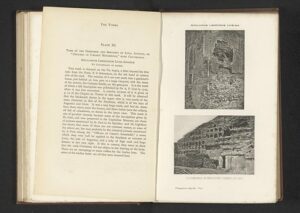
Like other pre-imperial burial chambers, the purpose of the Columbarium was a publicly accessible burial monument much like the modern cemetery – state sanctioned and region specific, where individuals or their descendants may purchase a “plot”, or a niche among the ollae (shelves) to safely house their remains and be recognized as a deceased citizen of the state.
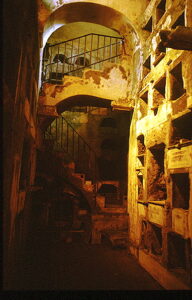
The Vigna Codini monument served to house cinerary remains and dedicated artifacts within each “cell” of the structure. The building of the Columbarium at Vigna Codini pre-dates early Christian burial practices of inhumation, which displayed itself in an early imperial shift in the 1st century CE. While the practice of inhumation in general did exist in Roman and pre-Roman practice, this model of the housing of human remains disappeared in large from ~200 BCE and re-emerged in Rome c. 1st century CE. Archaeological evidence notes that while inhumation via sarcophagi existed at the time as crematory burials, but were not as prominent in Roman culture before the imperial period. Cells were built to be uniform, with little space for modification and ornamentation.
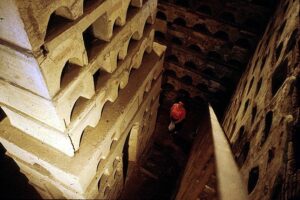
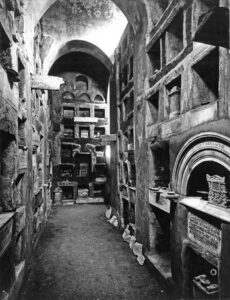
While some niches allowed space for an inscribed tablet or a small bust for the wealthier individuals, most niches only housed space to be personalized with brief inscriptions or solely just the name of the housed individual. The Augustan era and the first iteration of the Columbaria featured almost entirely identical niches, emphasizing the importance of equality of status in burial practice.[2] Each niche was modelled after the other and the appearance of the structure was largely uniform. Moving into the period of the late first century C.E., however, saw a transformation in funerary structure and culture as monuments began to include space for urns, as well as more personalized details such as altars, busts, and inscriptions.[3] The most significant modifications to niches are seen in Columbaria 3, as seen in Figure 4
Archaeological Reports and Remnants
Three separate Columbaria chambers along the Via Appia have been found — the first of which is said to have belonged to freedmen and servants of brother of Tiberius, who lived from 38 BCE-9 CE. This columbarium contained the most vast number of inscriptions, numbering upwards of 86.[4]
The first known excavation of the others occurred under Pius IV, reigning from 1559-66 CE, also devoted to countless freedmen of gens Pompeia, a high ranking familial class dating back to the early second century BCE.

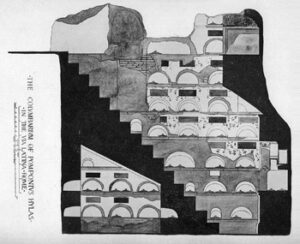
The first recorded excavation of 1726-33 under Francesco Bevilacqua describe the discovery of numerous hundreds of incinerate urns and detailed inscriptions still withholding color from their lettering and frescos. Many have maintained well preserved, but color images of these findings are not available under copyright as public resources (see Bridgeman Images). Other descriptions of excavations by scholars of the late 1890s depict the discovery of supulchral rooms and cinerariums, but records of these excavations are currently not available to the public.
Three properly and well documented excavations of the columbaria occurred in 1840, 1847, and 1852, respectively in regards to the 3 chambers excavated, by Pierre Campana and Gio Battista Guidi, though many scholars believe the third is perhaps is attributed to an archaeologist of the name Codini (the namesake of the monument).

The largest of the three contains 450 “dovecotes” and just below 300 inscriptions, many of which have been removed and dispersed to museums across the Mediterranean. Inscriptions and funerary tablet fragments from this site describe individuals belonging to numerous Imperial families under the reigns of both Tiberius and Claudius (early 1st century CE).
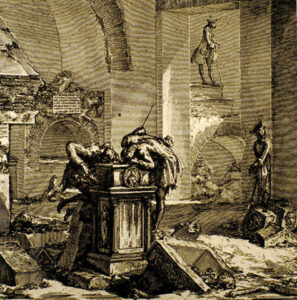
The second, discovered by Campana less than a decade later, is significantly smaller, with 295 ollae and containing over 400 funerary tablets retaining inscriptions with descriptions of the location and its inhabitants. The majority of the individuals housed in the second columbarium are attributed to the slaves and freedmen of the family of Marcella the Elder and the Younger, relatives through marriage of consul Marcus Agrippa (1st c. BCE)
The third columbarium, excavated by Guidi in the early 1850s, differs greatly in architecture as it exhibits high arched ceilings, larger and more scattered ollae of different sizes, as well as numerous artifacts, busts, and dumped human bones not bothered to be incinerated or housed in niches of their own, likely belonging to slaves of the lowest class and not attributed by any known inscriptions. Many of these artifacts which once were housed in funerary niches, however, have been lost to looting over the ages. Surviving artifacts remain in situ and managed by the Roman state or have been distributed to numerous museums across Italy over the last 200+ years.
Status in Public Burial
The institution of Columbaria as a public burial structure emerged in Imperial Rome around the same time (coincidentally?), as the social institution known as the collegium, or the dividing of social classes and associations as legal entities/defined groups. Classicist John Bodel argues that, “catacombs were not invented and designed to accommodate the particular ideological beliefs and religious behavior of early Christians” but rather to accommodate burial to the community outside of what is referred to as the “nuclear family” and provide a space for the non-elite classes of Rome as per the collegia.[5]
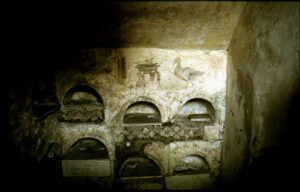
Figure 9, below, depicts a fresco on the first landing of the Columbarium, which has since crumbled and reveals the brickwork and marble behind it. This image displays the disparity of inscriptions, as only a small percentage of ollae included inscriptions at all. However, while labeless, many niches were colorfully decorated while not personalized to the individuals represented.
In regards to social status, the institution of the Columbaria allowed for a large public domain in which the lower classes of Rome could house their dead. Some scholars suggest the functionalist approach as reasoning for the use of columbaria, as a response to both rising land prices coupled with high death rates coming with the need to dispose of vast numbers of bodies in Rome as well as and the desire to record individual identity. Morris argues that this is a likely interpretation, while insisting on the symbolic aspect of the collective columbaria as a type of social structure which unifies members of the Roman statehood regardless of social class or citizenship status.[6]
Sources:
Bodel, John. “From Columbaria to Catacombs: Communities of the Dead in Pagan and Christian Rome – 2008,” n.d.
Borbonus, D. (Dorian). Columbarium Tombs and Collective Identity in Augustan Rome. Cambridge: Cambridge University Press, 2014.
Felle, Antonio E. “The ‘Written Death’ in Late Roman Collective Funerary Settlements. Some Case Studies from Rome (3rd-4th Cent. CE).” N. Zimmermann and Th. Fröhlich (Eds), The Economy of Death. New Research on Collective Burial Spaces in Rome from the Late Republic to the Late Roman Time, Heidelberg 38, no. 7.2 (2022): 89–101.
Jordan, D. R. “The Inscribed Gold Tablet from the Vigna Codini.” American Journal of Archaeology 89, no. 1 (1985): 162–67. https://doi.org/10.2307/504779.
Lanciani, Rodolfo Amedeo, 1847-1929. Ruins and Excavations of Ancient Rome [New York]: Blom, 1967.
L’hoir, Francesca Santoro. “Columbarium 3 at Vigna Codini: View of Double Staircase.” World History Encyclopedia. Last modified October 19, 2014. https://www.worldhistory.org/image/3150/columbarium-3-at-vigna-codini-view-of-double-stair/.
L’hoir, Francesca Santoro. “Fresco of Duck and Tripod, Columbarium 3, Vigna Codini.” World History Encyclopedia. Last modified October 19, 2014. https://www.worldhistory.org/image/3151/fresco-of-duck-and-tripod-columbarium-3-vigna-codi/.
Morris, Ian. Death-Ritual and Social Structure in Classical Antiquity. Cambridge: Cambridge University Press, 1992.
https://www.worldhistory.org/article/764/deaths-mansions-the-columbaria-of-imperial-rome/