
Sacred Spaces of the Ancient Mediterranean
Temple of Ares in Athens
Will Poniros
The Temple of Ares, now located in the Athenian Agora, is a hexastyle peripteral temple—meaning it has six columns across the front and is surrounded by a single row of columns on all sides. The colonnade on either side of the temple consists of 13 columns.
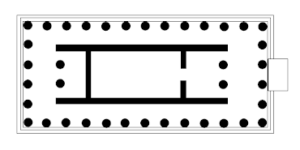
Like most Greek temples of its time, the Temple of Ares was constructed from Pentelic marble, the same material used for the Parthenon on the nearby Acropolis. The outer colonnade of the temple surrounded an inner cella, which was enclosed1. The Temple of Ares has a complicated history, being used in two very different periods, for different purposes. The temple was also disassembled and moved to its current location, where it was rebuilt and repurposed.
William Dinsmoor was one of the first to analyze the site upon its excavation and went into great detail about the measurements for all major blocks that were found. Later on, Marian McAllister reassessed Dinsmoor’s evidence and adjusted the temple’s dimensions to 16.125 m x 34.941 m. x 9.6875 m, which remains the agreed-upon dimensions2.
The Temple originated a good ways away from its current resting place in the Agora of Athens. Soon after the temple’s rediscovery and excavation, an initial analysis of the detailed workmanship proved that the Temple of Ares was originally erected by the Greeks in the age of Pericles (5th century B.C.E). These details, however, were contrasted by the presence of Roman Dowel holes in the columns and Augustan inscriptions etched into the blocks of the temple. These details allowed archaeologists to assume that the Romans reconstructed the Temple of Ares at least four centuries after its original construction3.

Many details pointed to this temples transportation including the Augustan inscriptions, a piece of pottery found in the temple’s foundations, as well as an analysis the temples connection to the Odeion of Agrippa and the local drainage system. These clues, coupled with more recent relative dating techniques set the transplantation between 15 B.C.E and 50 C.E4. Since the Temple is now in complete ruin, archaeologists have attempted to understand the context behind its deterioration. Working off of Pausanias’s writings, we can say with near certainty that the temple was intact into the late 2nd century C.E. However, only 70 or 80 years later, it was destroyed. This process of destruction is thought to have begun with the Herulian sack of Athens in 267 C.E, after that point there were no known repairs made and the temple was likely completely abandoned and built over5.
Once the determination was made that the Temple of Ares had been transported to its current location, Archaeologists began looking for its original location. In 1994, some well-preserved temple foundations were discovered by chance in a rescue excavation at Stavros (ancient Pallene), near the northeastern end of Mt. Hymettos, and three years later, Manolis Korres proved beyond reasonable doubt that the Temple of Ares originally must have stood upon them. This determination was made through a comparison of foundation dimensions as well as site context.

The mountain that existed beside these foundations was then determined to be the “sacred hill of Athena Pallenis” mentioned by Euripides in his Herakleidai of 430 B.C.E. It’s cult, shared among four demes and was dedicated to Athena Pallenis. This Cult worship was among the most famous in Attica, and it origi
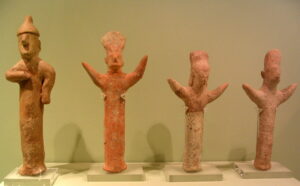
nally included Apollo, not Ares6. The history of the site at Pallene extends far earlier than the age of Pericles. The site was first an Archaic sanctuary as seen by the presence of terracotta figurine offerings, likely brought from all over Attica. The sanctuary expanded in the Classical period under Pericles with the building of a new Doric temple on a new east-west orientation. This new temple was dedicated to Athena Pallenis and Apollo7. The monumental entrance, large complex, and deep deposits of sacrifice refuse indicate to archaeologists that the sanctuary at Pallene hosted Attic festivals for centuries8.
The Greeks, during Augustus’s reign, disassembled it and moved it block by block to the Agora. It was only after this relocation that it was dedicated to Ares. Some Scholars believe that the temple was removed and rebuilt by Athenians themselves as a method to protect their cultural identity and sovereignty from the new imposition of Roman Imperialism9. These Athenian elites could have aimed to build an agora that symbolized the Athenians as collaborators with Rome in an attempt to maintain peace with the new power that had taken hold10. As for the reason behind the dedication being made to Ares instead of leaving it with Athena, scholars recognize that Athenians were a democratic people who preserved their traditions through just laws. Therefore, the god who maintained lawful peace through the threat of violence makes intuitive sense given the tumultuous nature of this period for Athenians11.
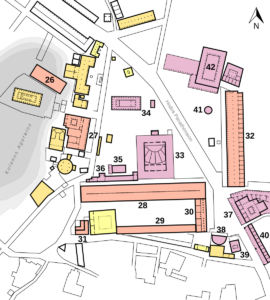
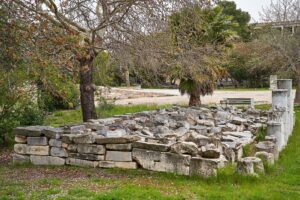
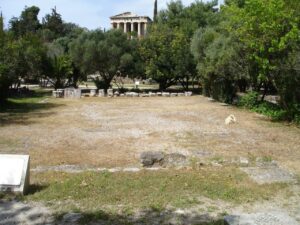
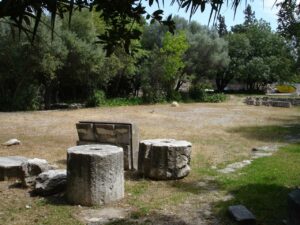
What remains of the Temple of Ares resides among many other impressive structures on the Agora, including its “twin” of sorts, the Temple of Hephaestus, another hexastyle temple of nearly identical proportions. Currently, the foundations of the Temple of Ares are little more than a large rectangular pit, sunken below the contemporary soil level12. The Altar of Ares lies about 10 m to the east of the temple. The altar itself now appears to be little more than a pile of neatly stacked rectangular stones with a few partial columns. Very little of this altar was exposed before excavations due to the presence of subsequent medieval foundations13. Although the material remains in the direct perimeter of the temple are limited, experts have attributed sculptural fragments of four larger-than-life-sized marble figures to the cult group of the Temple of Ares that Pausanias witnessed and wrote about upon visiting the ancient site. Two Aphrodites, Athena and Ares, were all potentially discovered in highly fragmented condition. We can’t be sure these statues actually originated in the Temple of Ares, especially Aphrodite and Athena, as none of these statues were found in situ and both of these deities had temples of their own nearby14.
A team led by Andrew Steward has attempted to recreate some of the frieze reliefs at the temple using some of the fragments found in the temple’s surroundings. Specifically, the east frieze was digitally reconstructed, which they believe depicted Poseidon overseeing Apollo joining a cult of Athena. This scene corroborates the assertion that the temple originally housed a shared cult of Athena and Apollo before it was deconstructed and transplanted at the Athenian Agora15.
Artifacts associated with the Temple of Ares are relatively few. Toward the west of the
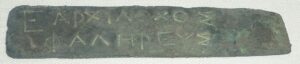
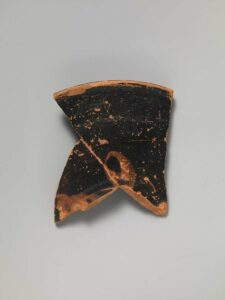
Temple’s foundation, the blocks have been stripped away down to a packing of stones in the bottom of the pit. Among the stone packing were found eleven silver-plated bronze coins of Athenian type, which have been dated in the third quarter of the fourth century B.C.E. From the same period, three fragmentary dikasts’ name-plates of bronze were also found. These artifacts from earlier periods were likely only included as fill material, accidental or otherwise16. It was in this cobble packing where a black-glazed terracotta sherd was found which was subsequently dated between the late first century B.C.E and the early first century C.E17. This confirmed other evidence favoring a date in the early Roman period for the laying of the temples new foundations.
The most influential artifacts found at the Temple of Ares relate to the high relief frieze fragments found scattered about the vicinity of the temple. These fragments are made of the same stone and have very similar stylistic elements, and proportions18. This collection comprises forty-nine fragments currently housed in the Stoa of Attalos. These frieze fragments can be attributed confidently to the Temple of Ares. One of these fragmented statues could depict Ares and is thought to be a marble copy of the original bronze cult statue housed in the Temple of Ares19.
When archaeologists first discovered the foundations of the Temple of Ares they were unsure who the temple was dedicated to until they connected a previous reference made by Pausanias during his travels to Greece which included an extensive piece of writing describing many major sites in great detail. It was in these descriptions that Pausanias mentioned the “sanctuary of Ares”20. At the Temple of Ares, Pausanias described the cult statue along with other works.
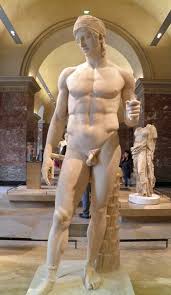
This is the only real evidence pointing to this temple being dedicated to Ares as no cult statues were found in situ at the site21. However one statue known as the Borghese Ares, was found southwest of the
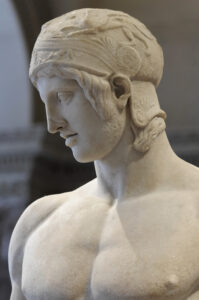
Temple and is thought to be a marble copy of the bronze original by Alkamenes that Pausanias saw in the Temple of Ares in the Athenian Agora22. Two classical texts that mentioned the sanctuary in its context at Pallene remained popular in the Early Roman Period. Both Herodotus in Histories and Euripides in Heraclidae set dramatic conflicts fought nearby the Temple of Athena Pallenis. Livy also reports Attic forces fleeing from Macedonians at Pallene23. Unfortunately Most information relating to what exactly was going on at the Temple while it stood at the Agora is speculative due to a lack of historical sources and archaeological remains.
Bibliography
1Dinsmoor, William Bell. “The Temple of Ares at Athens.” Hesperia 9, no. 1 (January 1940): 1. https://doi.org/10.2307/146631.
2McAllister, Marian Holland. “The Temple of Ares at Athens: A Review of the Evidence.” Hesperia 28, no. 1 (January 1959): 1. https://doi.org/10.2307/147338.
3Dinsmoor, William Bell. “The Temple of Ares at Athens.”
4Lents, Hannah Lisbeth. “Ares in Roman Athens: the Temple of Ares in its sacred landscapes.” PhD diss., 2020.
5Stewart, Andrew, et al. “Classical Sculpture from the Athenian Agora, Part 2: The Friezes of the Temple of Ares (Temple of Athena Pallenis).” Hesperia: The Journal of the American School of Classical Studies at Athens88, no. 4 (2019): 625-705.https://dx.doi.org/10.2972/hesperia.88.4.0625.
6Stewart, Andrew, et al. “Classical Sculpture from the Athenian Agora, Part 2: The Friezes of the Temple of Ares (Temple of Athena Pallenis).”
7Lents, Hannah Lisbeth. “Ares in Roman Athens: the Temple of Ares in its sacred landscapes.”
8 Lents, Hannah Lisbeth. “Ares in Roman Athens: the Temple of Ares in its sacred landscapes.”
9Lents, Hannah Lisbeth. “Ares in Roman Athens: the Temple of Ares in its sacred landscapes.”
10Lents, Hannah Lisbeth. “Ares in Roman Athens: the Temple of Ares in its sacred landscapes.”
11Lents, Hannah Lisbeth. “Ares in Roman Athens: the Temple of Ares in its sacred landscapes.”
12Dinsmoor, William Bell. “The Temple of Ares at Athens.”
13Dinsmoor, William Bell. “The Temple of Ares at Athens.”
14Lents, Hannah Lisbeth. “Ares in Roman Athens: the Temple of Ares in its sacred landscapes.”
15Stewart, Andrew, et al. “Classical Sculpture from the Athenian Agora, Part 2: The Friezes of the Temple of Ares (Temple of Athena Pallenis).”
16Dinsmoor, William Bell. “The Temple of Ares at Athens.”
17McAllister, Marian Holland. “The Temple of Ares at Athens: A Review of the Evidence.”
18Thompson, Homer A. “Excavations in the Athenian Agora: 1951.” Hesperia: The Journal of the American School of Classical Studies at Athens 21, no. 2 (1952): 83–113. https://doi.org/10.2307/146780.
19Stewart, Andrew, et al. “Classical Sculpture from the Athenian Agora, Part 2: The Friezes of the Temple of Ares (Temple of Athena Pallenis).”
20Pausanias. Description of Greece, Volume I: Books 1-2. Translated by W. H. S. Jones. Loeb Classical Library 93. Cambridge, MA: Harvard University Press, 1918. DOI: 10.4159/DLCL.pausanias-description_greece.1918
21Dinsmoor, William Bell. “The Temple of Ares at Athens.”
22Andrew Stewart. (2016). The Borghese Ares Revisited: New Evidence from the Agora and a Reconstruction of the Augustan Cult Group in the Temple of Ares. Hesperia: The Journal of the American School of Classical Studies at Athens, 85(3), 577–625. https://doi.org/10.2972/hesperia.85.3.0577
23Lents, Hannah Lisbeth. “Ares in Roman Athens: the Temple of Ares in its sacred landscapes.”