Chapters
Eating Disorders and Body Image in Athletics
Cait McAlindon, Camille Cortes, Evan Nilan, Emily Baker, and Anders Larson
Emily Baker
Although sports and exercise is often recognized for its positive impact on mental and physical well-being, there is an overlooked issue that many athletes face which is body image concerns. Girls and women in particular must navigate a unique dynamic between the physical expectations of their sport and the societal expectations of their bodies and appearance. Through focus groups and surveys taken by 102 girls aged 11-35, the participants revealed some insight into sports and the effects they have on their body image and mental health (Matheson et al. 2023). While sports can foster strength and confidence, they can also intensify the pressure one puts on themselves to have a certain body type. In this study, many women and girls expressed a preference for women-only interventions that not only empowered them to appreciate their bodies but also addressed harmful behaviors from others in their environment.
It was found that adolescent athletes are especially vulnerable to body image concerns and the effects they may have, reporting that negative body image affects their performance and willingness to participate in their sport (Sabiston et al. 2020). This issue goes beyond discomfort and carries serious mental health risks such as developing an eating disorder. Athletes face the paradox of needing strong bodies to perform, while also wanting to meet the societal standard of the ideal body type. For some women athletes such as rugby players, strength and muscularity is embraced on the field but criticized off of it which creates a split known as “contextual body image” (Burgon et al. 2023). Aesthetic and endurance athletes may receive validation for their lean figures, but still experience the pressure to maintain that look. While we promote the benefits of physical activity we must also ask: when does the pursuit of excellence in sports come at the expense of athletes’ mental health? While anyone can be at risk for developing an eating disorder, certain groups like athletes may face pressures that increase their vulnerability, and these kinds of pressures may depend on the type of sport they are involved in.
Anorexia, Bulimia and Disordered Eating Prevalence by Sport and Treatment
Evan Nilan

According to the National Eating Disorder Association Americans have a 9% lifetime risk of experiencing an eating disorder, 8.6% among females and 4.07% among males. In order to take on this problem it is important to recognize risk varies significantly by population.
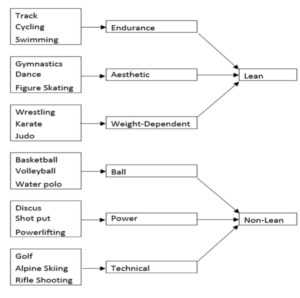
Sports populations for one may be at heightened risk depending on the category of sport. Those who participate in lean sports (which can be broken down into aesthetic and non aesthetic sub categories) are particularly prone to these disorders. Lean aesthetic sports are defined by their encouragement of thinness to maximize sports performance consisting of sports like gymnastics, diving, figure skating and ballet. Whereas, lean non aesthetic sports consist of endurance and weight dependent sports. Endurance sports include swimming, running and cycling, and weight dependent sports are those divided by weight class such as wrestling, judo and taekwondo. On the other hand non-lean sports participants are at lesser risk for eating disorders. Non-lean sports consist of ball sports such as basketball and baseball, power sports such as discus and shot put, and technical sports such as alpine skiing and golf. (Mancine et al. 2020)
Ballet is an example of an aesthetic lean sport, and has been particularly known for its high rates of disordered eating due to the cultural emphasis on body weight and shape. A study on eating psychopathology showed ballet dancers have higher tendencies to restrict food intake, and have a more intense drive for thinness than control subjects which drive disordered eating behaviors suggesting a particular risk for anorexia nervosa (Silverii et al. 2022). Furthermore, the estimated rate for clinical eating disorders in ballet dancers is 16.4% (Arcelus et al. 2020). Similar rates would be expected for figure skating and other lean aesthetic sports and so athletes in these sports should be regularly screened for signs that they may be struggling with disordered eating behaviors or thoughts.
Additionally, recent research on combat sports, which are non aesthetic lean sports in the weight dependent category are also cause for alarm, as a study on prevalence of disordered eating in these sports revealed 4 out of every 5 combat sport competitors have moderate to high Disordered Eating (DE) implications. Furthermore, most athletes showing signs of DE 7 days after a competition continue to display these behaviors at 28 days and beyond. This means excessive thoughts about burning calories when exercising, body dissatisfaction and healthy eating and behaviors such as skipping meals, compulsive exercise, binge eating, laxative use, and restrictive eating become seriously ingrained into the daily lives of these athletes beyond competition time (Doherty et al. 2024). Athletes in these sports should not only be screened for these behaviors but also should be taught healthy parameters for weight gain and loss, and should be encouraged to remain in the weight class that is healthiest and most natural for their body.
While helpful the groupings are not clear cut or perfect. Some power sports and the ball sport water polo also have been shown to have significantly higher rates of disordered eating compared to controls (Mancine et al. 2020). One could also argue that since some power sports such as powerlifting have weight classes that a sport of that type is also a weight dependent lean sport. As for water polo it requires the athletes to be proficient at swimming (which is in the lean category). This implies sports could be considered to fall under multiple categories. As a whole, these categories are not meant to be rigid rules, but serve to assist in identifying at risk groups and in developing and implementing appropriate interventions.
A longitudinal study on the long term impact of implementing an eating disorder prevention program on ballet students suggests that providing athletes groups to discuss disordered eating and body image and making systematic changes to the culture of the school or club can increase resilience to the mental toll of the sport and decrease disordered eating and purging behaviors (Bar et al. 2017). Studies and programs like this should become increasingly common in at-risk sports categories, as prevention is key in lowering the number of Americans affected by eating disorders. To learn more about eating disorder prevalence in athletes and treatment, visit Eating Disorders and Athletes – National Eating Disorders Association.
Psychological Factors that put Athletes at Risk for Developing Eating Disorders
Camille Cortes
The severity of eating disorders is often overlooked where under eating is talked about in a joking manner without the recognition that unhealthy eating habits can easily lead to life threatening eating disorders. Disordered eating is the term used to describe an individual’s eating habits that put them at risk for developing an eating disorder, which is a medically diagnosed eating condition (Stoyel et al., 2021). Athletes are especially susceptible to developing eating disorders as shown in a study done in 2023 which found that among 40 different division 1 and division 2 institutions, 25.3% of over 1,000 surveyed athletes were classified as at risk for eating disorders (Torres-McGehee et al., 2023). When looking at psychological factors that cause an individual to be at risk for developing an eating disorder, a widely accepted theoretical etiological model (a type of model that predicts behavior based on its causes and development) was developed in 2007 by Petrie and Greenleaf which outlines risk factors for eating disorders, the psychological factors include sports and societal pressures, internalization, body dissatisfaction, and negative affect (Stoyel et al., 2020).
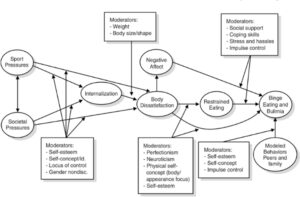
One of the most pressing psychological risk factors for eating disorders in athletes has been found to be societal pressures, where there are conflicting standards of what is considered an “attractive figure” versus an “athletic figure” portrayed through social media (Stoyel et al., 2021). In a longitudinal study, researchers found that when discussing social media in a survey completed by athletes, the “thin ideal” idolized in social media often leads to body dissatisfaction (unpleasant feelings regarding your body), decreased self-worth, and therefore is a strong predictor of the development of eating disorders in athletes (Stoyel et al., 2021). The impact of social media and societal pressures on body image is strongly correlated to internalization and body dissatisfaction, where internalization in the context of body dissatisfaction is the result of having an “ideal” body imaged based on the societal beauty standards that is usually unattainable or unrealistic when factoring in the caloric and muscular needs that come with being an athlete. These thoughts lead to comparison and a poor perception of self-worth based on body image which leads to the risk for eating disorders to develop in response to the desire to attain a particular figure.
In addition to societal pressures, internalization, and body dissatisfaction, certain negative emotions and characteristics are indicators of an increased risk in developing an eating disorder, Petrie and Greenleaf describe this as a negative effect (Stoyel et al., 2020). Some characteristics that can classify athletes as at risk to develop eating disorders include perfectionism, impulsiveness, fearfulness, and vulnerability (Torres-McGehee et al., 2023). While these characteristics can be present in any individual, they are especially common in athletes due to athletic induced pressures which create an excess amount of stress revolving around your performance as an individual. There are many sports where there is a stigma that being thinner and weight less will improve your performance where 30% of males who were surveyed and identified as high risk for eating disorders were track/cross country athletes, one of the many sports where being “thin” is considered beneficial to performance (Torres-McGehee et al., 2023). Perfectionistic, fearful, and impulsive emotions can lead to a panic during times of poor performance promoting poor perception of self-worth leading to body dissatisfaction and the desire to lose weight due to the idea that looking a certain way and being lean will improve athletic performance.
Eating disorders can lead to major health concerns and possibly prevent an individual from being able to engage in athletics and exercise as a whole once it gets to a certain severity. It is important that coaches and athletes are properly informed about the many psychological factors that increase risk for developing eating disorders, the signs of eating disorders developing, and the various types of eating disorders. As mentioned above, one of the psychological predispositions to the development of eating disorders is the perfectionistic mindset which is instilled in many athletes through the pressures surrounding their performance, routine, and diet. One type of eating disorder that is not talked about enough is Orthorexia Nervosa, which stems from this perfectionist mindset.
Orthorexia Nervosa: An Underrecognized Form of Disordered Eating
Cait McAlindon
It’s common knowledge that a conscientious diet and regular exercise are important for one’s well-being, but what happens when we become perfectionists about it? Orthorexia nervosa (ON), stemming from the Greek words ortho, meaning correct, and rexia, meaning appetite, describes a dysfunctional obsession with healthy eating and behaviors that leads to clinical complications, obstructs everyday functioning, and causes increasingly strict diets over time (Scarff, 2017). A critical component of ON is the dichotomous categorization of foods into “healthy” and “not healthy” and restrictive or very strict dietary practices. Those with ON experience intense shame when they break their own rules; their self-image and self-worth are reliant upon their adherence to their high expectations for what they consider to be healthy. Anxiety, especially surrounding that of one’s body image or self-perception of health, a need for control, and perfectionism creates the perfect storm for the development of ON (Scarff, 2017).
The dysfunctional fixation with following rigid rules of perceived healthy habits clearly shows strong motivation to maintain one’s well-being. Therefore, it isn’t much of a surprise that there’s overlap between groups that exercise and those with ON. Hafstad et al. (2023) found a high prevalence of ON in exercising populations as compared to non-exercising populations. Additionally, Uriegas et al. (2021) confirm that collegiate student athletes are at risk for ON.
Since we know that a healthy lifestyle can greatly benefit us, it’s important to distinguish associated factors between a healthy orthorexia and orthorexia nervosa. Work done by Anastasiades & Argyrides (2022) found that a few different factors are differently correlated with healthy and pathological orthorexia. As one might expect, intuitive eating and measures of positive body image were positively correlated with healthy orthorexia and negatively with ON.
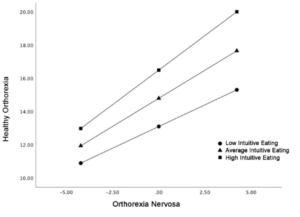
Additionally, Liu et al. (2024) supported the negative correlation between positive body image and ON behaviors, suggesting that body appreciation could be a protective factor against the development of ON. It’s thought that those with higher levels of body appreciation are likely to experience more self-compassion, which limits rigid dietary rules and allows for more flexibility. This can also carry over into helping prevent negative mood states after diverging from one’s perceived healthy eating, mitigating feelings of guilt and shame. It has also been found that adolescent athletes specifically have higher reported levels of ON, with inadequate relationships with parents as a predictive factor (D’Urso et al., 2023). A 2021 study on Hungarian adults describes another interesting association: Bóna et al. found that low self-esteem can be a predictive factor for ON development. Interestingly enough, this study found that this relationship between ON behaviors and low self-esteem can be mediated by spiritual beliefs. It’s suggested that this may occur because spiritual beliefs can boost one’s self-esteem, providing protection against ON through positive perceptions about one’s body and eating habits.
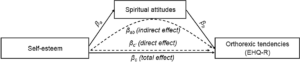
Due to the fact that a fixation on health is in the nature of ON, it’s easy for it to go under the radar as a form of disordered eating. However, it’s important to be able to recognize these signs, as ON can become debilitating and lower your quality of life. Overall, working on one’s self-esteem and positive body image, as well as body appreciation and potentially spirituality, can possibly provide protection against the symptoms of ON. With these relevant findings and the previous sections of this chapter, social and psychological factors relating to eating disorders have been discussed. Now, a look into the physical ramifications of an eating disorder and their effects on performance is appropriate.
The performance drop off related to eating disorders and the problems with “making weight”
Anders Larson
Now that we know a little bit about the prevalence and psychological causes of eating disorders from an athletic standpoint, we can begin to ask questions about how these issues might affect the performance and physical ability of affected athletes. Our bodies are finely tuned machines and require a lot of different things to go right in order for us to compete and exercise at the highest levels. Eating disorders can seriously impact our ability to function properly and can affect a number of different bodily functions and needs related to athletic performance. These disorders are known to have negative effects on physical fitness and performance by causing things like low energy and excessive loss of both lean mass and fatty tissue. Eating disorders can also cause deficiencies in a lot of vital nutrients, especially things like electrolytes, when it comes to athletics (El Ghoch et al, 2013). These issues can have different effects depending on the sport each person participates in. As mentioned previously, different sports can cause athletes to develop different types of disorders with different unhealthy eating habits.
These negative health effects are a really big problem in sports and events where they are pretty much unavoidable for a large number of susceptible people. These issues come with sports where weight and one’s body is an integral part of the sport. There really are a lot of sports that require athletes to look a certain way or, more often, weigh a certain amount. Sports like wrestling or boxing require athletes to “make weight” which can lead to a lot of problems. Other niche events like pole vault require athletes to be under a certain weight in order to be safe on the poles they are using. These are just a few examples where weight is a vital part of one’s athletic performance. The problem here is that weight is a huge factor because it simply has to be. In these cases it’s necessary to regulate weight as an important safety measure. It’s an unavoidable issue that can lead to unintended consequences. If an athlete is forced to keep track of their weight for long enough it can become obsessive and unhealthy. One study looking at the connections between weight regulation in wrestlers bulimia nervosa showed that, while evidence did not suggest that it was serious to make a formal bulimia diagnosis, a lot of the weight regulation tactics used by the wrestlers were similar to the negative weight loss tactics used by bulimics (Dale et al, 1999). In a sport like wrestling where one’s physical ability is so important, these sorts of weight cutting tactics can have the same negative health effects as eating disorders.
As mentioned before, another good example of a sport where weight regulation can have negative effects on healthy eating is pole vault. Track and field as a whole is a sport that requires a ton of speed, strength, and endurance for all of its athletes. In order to compete at one’s best they need to be in the best shape they can possibly be in. Pole vault is one of, if not the most, technical event in the sport. Pole vault poles are separated by two categories, the length of the pole and the weight in pounds that the bend of the pole is designed to withstand. If a 170lb person is vaulting on a pole designed for someone that is 140lbs there is a huge risk of the pole snapping which can be really dangerous. It’s a very niche sport which makes it really difficult to get new poles if the athlete gains too much weight for the poles that they have. This can lead to an unhealthy regulation of one’s weight and in turn a drop off in performance. It’s a difficult cycle to break and in turn is a great example of why having weight requirements in certain sports can contribute to the development of eating disorders and or unhealthy relationships with food. The problem with these sports is that, while there are healthier tactics for these athletes to “make weight”, it’s difficult to get them to adhere to those tactics as they may take more effort or they may not be as simple as the unhealthy ones (Noonan-Holohan et al, 2024).
Conclusion
Eating disorders are a significant health risk for those in sport, causing mental distress and performance deficits through physical consequences. Those in aesthetic lean sports are particularly prone to the development of eating disorders, and those in weight-class sports are forced to keep a close eye on their weight and drastically change it over short periods of time. Factors such as positive body image, self-compassion, and intuitive eating are implicated in the protection against eating disorders. Overall, as a largely societal standard-driven subset of disorders, it’s important that we advocate and educate those around us about the risks of eating disorders, and what might make us particularly vulnerable.
References
Anastasiades, E., & Argyrides, M. (2022). Healthy orthorexia vs orthorexia nervosa: associations with body appreciation, functionality appreciation, intuitive eating and embodiment. Eating and Weight Disorders, 27(8), 3197–3206. 10.1007/s40519-022-01449-9
Arcelus, J., Witcomb, G. L., & Mitchell, A. (2014). Prevalence of eating disorders amongst dancers: a systemic review and meta-analysis. European eating disorders review : the journal of the Eating Disorders Association, 22(2), 92–101. https://doi.org/10.1002/erv.2271
Bar, R. J., Cassin, S. E., & Dionne, M. M. (2017). The long-term impact of an eating disorder prevention program for professional ballet school students: A 15-year follow-up study. Eating Disorders: The Journal of Treatment & Prevention, 25(5), 375–387. https://doi.org/10.1080/10640266.2017.1308731
Burgon, R. H., Beard, J., & Waller, G. (2023). Body image concerns across different sports and sporting levels: A systematic review and meta-analysis. Body Image, 46, 9–31. https://doi.org/10.1016/j.bodyim.2023.04.007
Bóna, E., Erdész, A., & Túry, F. (2021). Low self-esteem predicts orthorexia nervosa, mediated by spiritual attitudes among frequent exercisers. Eating and Weight Disorders, 26(8), 2481–2489. 10.1007/s40519-020-01095-z
DALE, K. S., & LANDERS, D. M. (1999). Weight control in wrestling: eating disorders or disordered eating? Medicine & Science in Sports & Exercise, 31(10), 1382. https://doi.org/10.1097/00005768-199910000-00004
Doherty, C. S., Fortington, L. V., & Barley, O. R. (2024). Prevalence of disordered eating and its relationship with rapid weight loss amongst male and female combat sport competitors: A prospective study. Journal of Science and Medicine in Sport, 27(11), 745–752. https://doi.org/10.1016/j.jsams.2024.06.007
D’Urso, G., Maynard, A., Lionetti, F., Spinelli, M., & Fasolo, M. (2023). Parental relationships, emotion regulation and orthorexia: A study on adolescent athletes. Nutrition and Health (Berkhamsted), , 2601060231194825. 10.1177/02601060231194825
El Ghoch, M., Soave, F., Calugi, S., & Dalle Grave, R. (2013). Eating disorders, physical fitness and sport performance: A systematic review. Nutrients, 5(12), 5140–5160. https://doi.org/10.3390/nu5125140
Hafstad, S. M., Bauer, J., Harris, A., & Pallesen, S. (2023). The prevalence of orthorexia in exercising populations: a systematic review and meta-analysis. Journal of Eating Disorders, 11(1), 15. 10.1186/s40337-023-00739-6
Liu, C., Messer, M., Anderson, C., McClure, Z., & Linardon, J. (2024). Body appreciation predicts lower levels of orthorexia nervosa symptoms: Prospective findings. Body Image, 48, 101684. 10.1016/j.bodyim.2024.101684
Mancine, R. P., Gusfa, D. W., Moshrefi, A., & Kennedy, S. F. (2020). Prevalence of disordered eating in athletes categorized by emphasis on leanness and activity type – a systematic review. Journal of eating disorders, 8, 47. https://doi.org/10.1186/s40337-020-00323-2
Matheson, E. L., Schneider, J., Tinoco, A., Silva-Breen, H., LaVoi, N. M., & Diedrichs, P. C. (2023). How can we help you? A global investigation into girls’ body image experiences in sport and intervention preferences. Body Image, 46, 265–279. https://10.1016/j.bodyim.2023.06.012
Noonan-Holohan, S., Cullen, S. J., Dunne, A., Warrington, G., Fitzpatrick, P., Pugh, J., McGoldrick, A., & Losty, C. (2024). The behavioural determinants of weight-making in weight-category sports: A narrative review. Performance Enhancement & Health, 100273. https://doi.org/10.1016/j.peh.2024.100273
Sabiston, C. M., Lucibello, K. M., Kuzmochka-Wilks, D., Koulanova, A., Pila, E., Sandmeyer-Graves, A., & Maginn, D. (2020). What’s a coach to do? Exploring coaches’ perspectives of body image in girls sport. Psychology of Sport and Exercise, 48, 101669. https://10.1016/j.psychsport.2020.101669
Scarff, J. R. (2017). Orthorexia Nervosa: An Obsession With Healthy Eating. Federal Practitioner, 34(6), 36–39. https://www.ncbi.nlm.nih.gov/pubmed/30766283
Silverii, G. A., Benvenuti, F., Morandin, G., Ricca, V., Monami, M., Mannucci, E., & Rotella, F. (2022). Eating psychopathology in ballet dancers: a meta-analysis of observational studies. Eating and weight disorders : EWD, 27(2), 405–414. https://doi.org/10.1007/s40519-021-01213-5
Slater, A., & Tiggemann, M. (2011). Gender differences in adolescent sport participation, teasing, self-objectification and body image concerns. Journal of Adolescence (London, England.), 34(3), 455–463. https://10.1016/j.adolescence.2010.06.007
Stoyel, H., Shanmuganathan-Felton, V., Meyer, C., & Serpell, L. (2020a). Psychological risk indicators of disordered eating in athletes. PLOS ONE, 15(5). https://doi.org/10.1371/journal.pone.0232979
Stoyel, H., Stride, C., Shanmuganathan-Felton, V., & Serpell, L. (2021). Understanding risk factors for disordered eating symptomatology in athletes: A prospective study. PLOS ONE, 16(9). https://doi.org/10.1371/journal.pone.0257577
Torres-McGehee, T. M., Uriegas, N. A., Hauge, M., Monsma, E. V., Emerson, D. M., & Smith, A. B. (2023). Eating disorder risk and pathogenic behaviors among collegiate student-athletes. Journal of Athletic Training, 58(10), 803–812. https://doi.org/10.4085/1062-6050-0539.22
Uriegas, N. A., Winkelmann, Z. K., Pritchett, K., & Torres-McGehee, T. M. (2021). Examining Eating Attitudes and Behaviors in Collegiate Athletes, the Association Between Orthorexia Nervosa and Eating Disorders. Frontiers in Nutrition (Lausanne), 8, 763838. 10.3389/fnut.2021.763838